FILTER
FILTER





Melbourne Instruments - Nina
New
2 999,17 €
excl VAT
Preorder
Arrival expected on Nov 6, 2026
Guarantee 3
years

Fred

Eric
Do you need help?
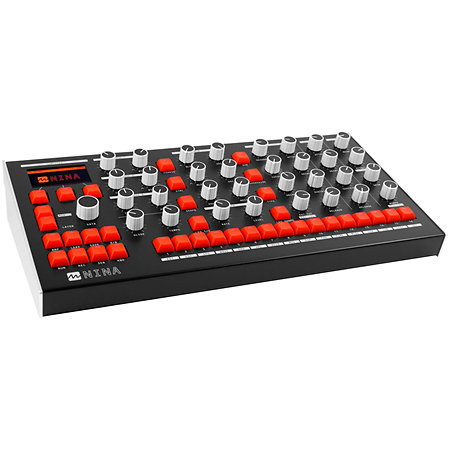
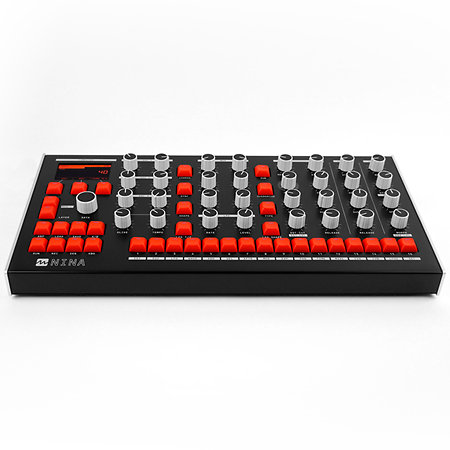
Melbourne Instruments NINA is a 12-voice polyphonic analogue synthesiser designed to combine the warmth of analogue VCOs with a particularly modern interface. Its motorised knobs automatically recall each setting, whilst morphing, MPE compatibility, four multitimbral parts and a four-track sequencer open up a wealth of possibilities both in the studio and on stage.
ARTICLE N° 126130
Melbourne Instruments - Nina
Melbourne Instruments - Nina
New
2 999,17 €
excl VAT
Preorder
Arrival expected on Nov 6, 2026
Guarantee 3
years
Fred
Eric
Do you need help?
Presentation
Melbourne Instruments NINA: the analogue synthesiser that truly remembers your actions
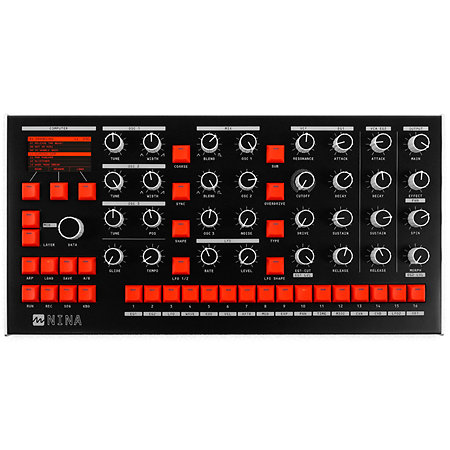
NINA reimagines the concept of the analogue synthesiser by adding a feature that traditional instruments simply cannot offer: motorised controls capable of physically moving to recall the parameters of a sound. When you load a preset, the knobs automatically return to their positions; when you modulate a parameter or automate a movement, NINA can also show you this directly on its control surface.
At the heart of the instrument are 12 synthesis voices, each featuring two discrete analogue VCOs and a digital wavetable oscillator. The 4-pole transistorised ladder filter can range from a smooth and precise response to much more aggressive saturation. Added to this is the Mutable Instruments Braids engine, offering 45 synthesis models and considerably expanding NINA’s sonic territory.
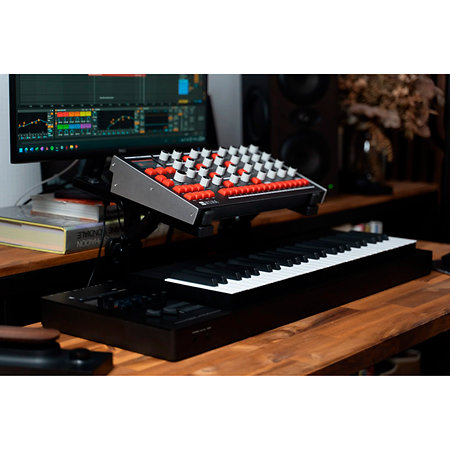
Morphing between two patches allows you to create complex sonic transitions, whilst the 16-source/27-destination modulation matrix enables highly advanced programming. MPE compatibility across all 12 voices also allows full use of expressive controllers such as the Expressive E Osmose or the LinnStrument.
NINA also functions as a true multitimbral instrument: up to four independent layers can be used simultaneously, with configurable voice distribution, splits and note ranges. The new sequencer adds four polyphonic tracks, each capable of up to 64 steps, with independent lengths, step automation, probability, micro-timing, shuffle and clock multiplication.
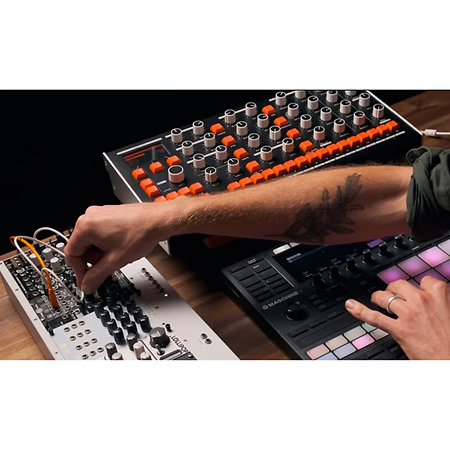
For sound designers, producers, electronic musicians and performers, NINA thus combines programming depth, tactile immediacy and unusual performance possibilities within a single desktop/rack-mounted synthesiser.
MPE compatibility: exceptional polyphonic expressiveness
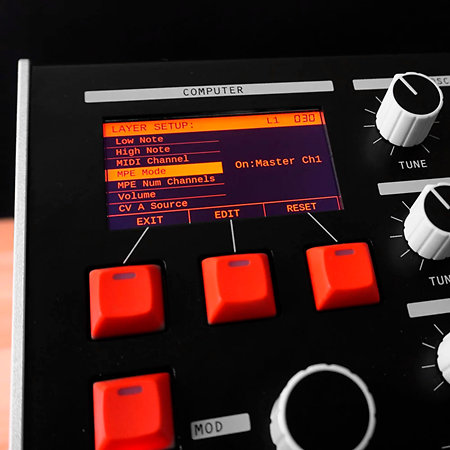
NINA supports MIDI Polyphonic Expression (MPE) across its 12 voices, allowing each note played to be controlled independently: pitch (Pitch Bend), pressure (Aftertouch) and timbre via MIDI CC#74. Each finger can thus modulate a note individually without affecting the others. NINA can be used in conjunction with the Expressive E Osmose, LinnStrument, Seaboard, ERAE Touch and other devices.
NINA reimagines the concept of the analogue synthesiser by adding a feature that traditional instruments simply cannot offer: motorised controls capable of physically moving to recall the parameters of a sound. When you load a preset, the knobs automatically return to their positions; when you modulate a parameter or automate a movement, NINA can also show you this directly on its control surface.
At the heart of the instrument are 12 synthesis voices, each featuring two discrete analogue VCOs and a digital wavetable oscillator. The 4-pole transistorised ladder filter can range from a smooth and precise response to much more aggressive saturation. Added to this is the Mutable Instruments Braids engine, offering 45 synthesis models and considerably expanding NINA’s sonic territory.
Morphing between two patches allows you to create complex sonic transitions, whilst the 16-source/27-destination modulation matrix enables highly advanced programming. MPE compatibility across all 12 voices also allows full use of expressive controllers such as the Expressive E Osmose or the LinnStrument.
NINA also functions as a true multitimbral instrument: up to four independent layers can be used simultaneously, with configurable voice distribution, splits and note ranges. The new sequencer adds four polyphonic tracks, each capable of up to 64 steps, with independent lengths, step automation, probability, micro-timing, shuffle and clock multiplication.
For sound designers, producers, electronic musicians and performers, NINA thus combines programming depth, tactile immediacy and unusual performance possibilities within a single desktop/rack-mounted synthesiser.
MPE compatibility: exceptional polyphonic expressiveness
NINA supports MIDI Polyphonic Expression (MPE) across its 12 voices, allowing each note played to be controlled independently: pitch (Pitch Bend), pressure (Aftertouch) and timbre via MIDI CC#74. Each finger can thus modulate a note individually without affecting the others. NINA can be used in conjunction with the Expressive E Osmose, LinnStrument, Seaboard, ERAE Touch and other devices.
Features
Type of sound generator
Analog
Arpeggiator
Yes
Headphone output
1
Analog output
4
Screen
Yes
MIDI port
Yes
USB port
Yes
Weight
5,5 kg
Type of backup
Internal
Power supply
Power adapter (included)
Country of production
Australia
Color
Black, Black
Packaging
Single unit
Other features
-
Melbourne Instruments Nina
-
Technical specifications:
-
12-voice polyphonic analogue synthesiser
-
4-part multitimbral architecture (sound layers or sequencer tracks)
-
35 motorised knobs with instant parameter recall
-
15-bit resolution (over 16,000 positions)
-
3 oscillators per voice: 2 analogue VCOs and 1 digital wavetable oscillator (wavetable with Braids synthesis)
-
4-pole transistor ladder analogue filters with resonance and overdrive
-
2x ADSR envelopes and 2x LFOs per voice
-
Full modulation matrix (16 sources, 28 destinations)
-
Patch morphing for smooth transitions between sounds
-
Built-in sequencer with step sequencer, arpeggiator and multitrack sequencer
-
4-track multitrack sequencer with up to 64 steps per track
-
Step-by-step parameter locks, micro-timing, shuffle and probability functions
-
Built-in effects: delay, chorus and reverb (96 kHz / 24-bit)
-
Spin Stereo Infinite Panner for spatial sound movement
-
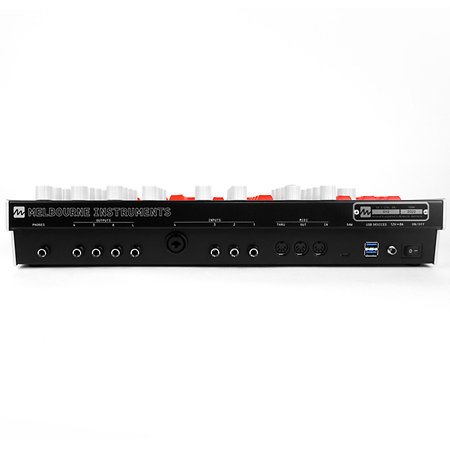
4x line outputs (main stereo output + 2x auxiliary outputs) and headphone output
-
Audio inputs compatible with line, CV or microphone signals
-
MIDI In / Out / Thru (DIN), MIDI via USB
-
2x USB-A ports for MIDI devices and 1x USB-C host port for a computer
-
CV inputs accepting voltages up to ±10 V
-
Supplied with a 12V DC power supply and a 19" rack-mount kit
-
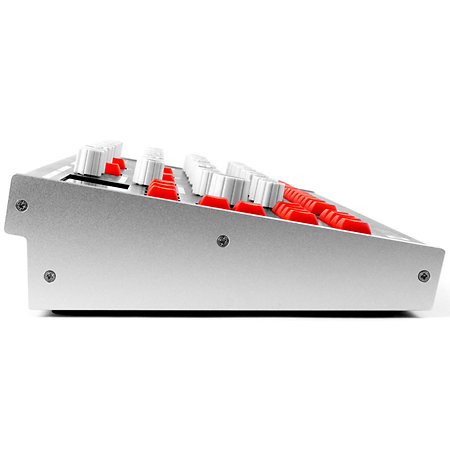
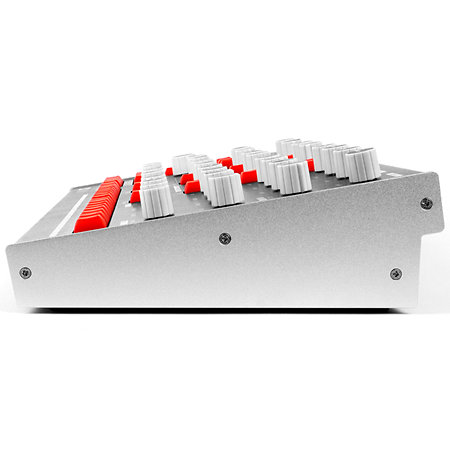
Dimensions: 44.6 × 23 × 7.1 cm
-
Weight: 5.5 kg
To find out more...
The CV inputs are also audio inputs: NINA can therefore be used as a fully-fledged interface between modular synthesis and internal synthesis, and not just as a MIDI synthesiser.
The MPE setting allows you to select either Bipolar or Unipolar polarity for CC#74, depending on the controller used. The manual specifically recommends Bipolar mode for the LinnStrument, ERAE Touch and Seaboard, and Unipolar mode for the Osmose by Expressive-E.
Internal audio feedback is particularly useful for creating much more aggressive timbres: the output signal can be fed back into the voices.
To preserve the analogue character as much as possible when using effects, opt for parallel mode: the manufacturer states that this preserves the analogue signal.
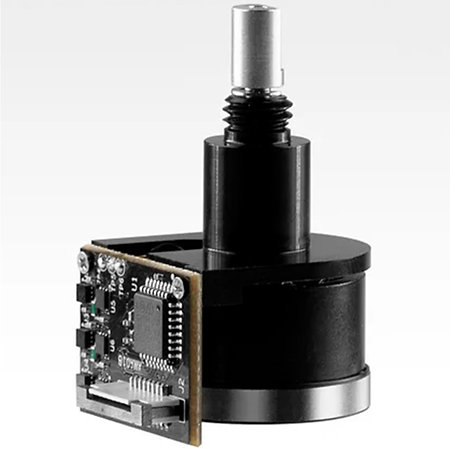
The motorised potentiometers are not mere encoders: with their contactless optical sensors and 15,000-step resolution, they allow for extremely precise control of parameters.
User wavetables are WAV files, which means they can be prepared on a computer using standard audio tools. Be mindful, however, of the maximum capacity: the manual states that the total number of loaded wavetables, including factory presets, must not exceed 127.
NINA can be updated without a computer: the manual provides instructions for installing the firmware via a USB stick formatted to FAT32.
Finally, the open-source and hackable nature of the Raspberry Pi 4 / Elk Audio OS architecture is a particularly interesting feature for advanced users: NINA is not just a closed-system synthesiser, but an audio computing platform designed to be scalable.
The MPE setting allows you to select either Bipolar or Unipolar polarity for CC#74, depending on the controller used. The manual specifically recommends Bipolar mode for the LinnStrument, ERAE Touch and Seaboard, and Unipolar mode for the Osmose by Expressive-E.
Internal audio feedback is particularly useful for creating much more aggressive timbres: the output signal can be fed back into the voices.
To preserve the analogue character as much as possible when using effects, opt for parallel mode: the manufacturer states that this preserves the analogue signal.
The motorised potentiometers are not mere encoders: with their contactless optical sensors and 15,000-step resolution, they allow for extremely precise control of parameters.
User wavetables are WAV files, which means they can be prepared on a computer using standard audio tools. Be mindful, however, of the maximum capacity: the manual states that the total number of loaded wavetables, including factory presets, must not exceed 127.
NINA can be updated without a computer: the manual provides instructions for installing the firmware via a USB stick formatted to FAT32.
Finally, the open-source and hackable nature of the Raspberry Pi 4 / Elk Audio OS architecture is a particularly interesting feature for advanced users: NINA is not just a closed-system synthesiser, but an audio computing platform designed to be scalable.