
FILTER
FILTER
Wharfedale - SL 824 USB
This product is no longer available for sale
These models in stock may be of interest to you:



374,17 €
excl VAT
including eco-part : 0,90 €
Guarantee 3
years

Louis
Do you need help?
10 Channel Mixing Console with USB Interface Wharfedale Pro SL 824 USB
ARTICLE N° 32378
Wharfedale - SL 824 USB
Wharfedale - SL 824 USB
374,17 €
excl VAT
including eco-part : 0,90 €
Guarantee 3
years
Louis
Do you need help?
Presentation
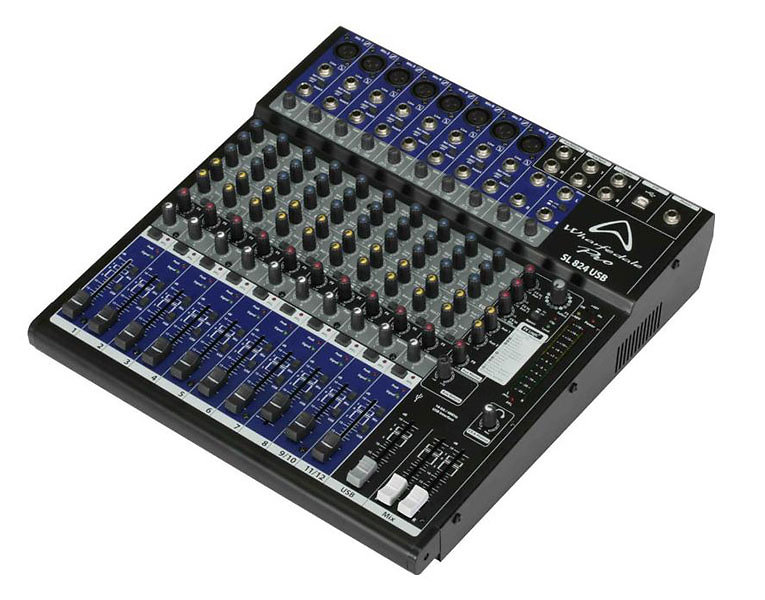
The Wharfedale Pro SL 824 USB console is designed for both studio and live use, thanks to its integrated USB duplex interface.
Designed to cover a wide range of mid-format mixing functions, the SL 824 includes many features suitable for both types of performance.
Designed to cover a wide range of mid-format mixing functions, the SL 824 includes many features suitable for both types of performance.
Other features
-
Wharfedale Pro SL 824 USB
-
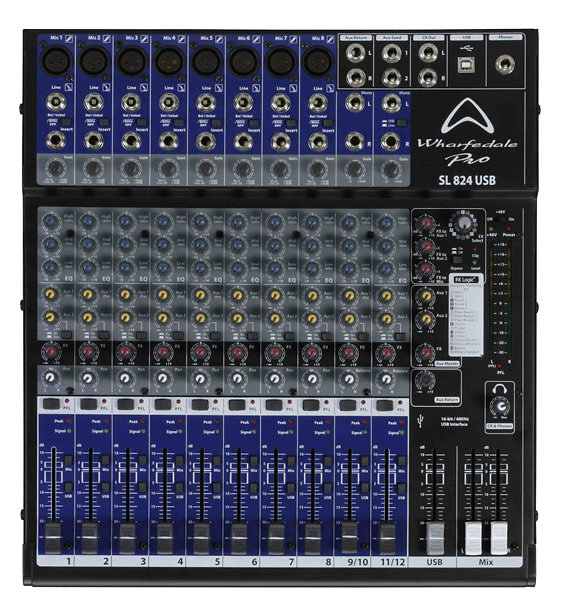
8-input mixer + USB
-
Full duplex 2in/2out 16-bit 48kHz via USB interface
-
Dedicated USB port for recording
-
Switchable line/USB return channel
-
8 microphone preamps with phantom powering
-
3-band EQ with high-pass filters
-
Built-in multi-effects
-
2 aux sends
-
Dedicated stereo return with level control
-
PAN and Balance controls
-
PFL on each channel
-
Room control and headphone output
-
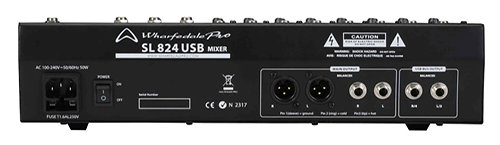
XLR and 6.35 mm jack master outputs
-
Weight : 5.2 kg
-
Dimensions: 80mm x 400mm x 369mm
To find out more...
A little history...
In 1932, Gilbert Briggs, a skilled technician, built his first loudspeaker in the cellar of his family home in Yorkshire, at Ilkley in the Wharfe Valley ('dale' meaning 'dale'). He decided to market it the following year and opened his first workshop near Bradford to manufacture his loudspeakers on a larger scale.
Radio was booming before the war, and the small company, a subcontractor to the major brands, was able to take full advantage of this new business.
The war brought its share of innovations, and demand grew for products capable of reproducing sounds as faithfully as possible (Ici, Radio Londres...).
With peace restored, Wharfedale invented the first two-way loudspeaker, featuring a ten-inch tweeter and a crossover, a technological innovation that would change acoustic reproduction forever.
In 1958, Gilbert Briggs sold his company to Rank, but remained at the helm, continuing to innovate (notably using ceramic magnets) before taking a well-deserved retirement seven years later.
From the 1960s onwards, the company took a keen interest in the hi-fi market, producing tuners, amplifiers and even turntables, while maintaining its leadership in loudspeaker manufacture. In 1992, Wharfedale merged with Mission to become Verity Group PLC and concentrated on sound reinforcement, for which there was huge demand, marketing a whole range of professional loudspeakers for touring musicians.
A department that became independent under the name Wharfedale Pro before joining Audiolab and Quad, part of IAG (International Audio Group) and setting up in China.
In 1932, Gilbert Briggs, a skilled technician, built his first loudspeaker in the cellar of his family home in Yorkshire, at Ilkley in the Wharfe Valley ('dale' meaning 'dale'). He decided to market it the following year and opened his first workshop near Bradford to manufacture his loudspeakers on a larger scale.
Radio was booming before the war, and the small company, a subcontractor to the major brands, was able to take full advantage of this new business.
The war brought its share of innovations, and demand grew for products capable of reproducing sounds as faithfully as possible (Ici, Radio Londres...).
With peace restored, Wharfedale invented the first two-way loudspeaker, featuring a ten-inch tweeter and a crossover, a technological innovation that would change acoustic reproduction forever.
In 1958, Gilbert Briggs sold his company to Rank, but remained at the helm, continuing to innovate (notably using ceramic magnets) before taking a well-deserved retirement seven years later.
From the 1960s onwards, the company took a keen interest in the hi-fi market, producing tuners, amplifiers and even turntables, while maintaining its leadership in loudspeaker manufacture. In 1992, Wharfedale merged with Mission to become Verity Group PLC and concentrated on sound reinforcement, for which there was huge demand, marketing a whole range of professional loudspeakers for touring musicians.
A department that became independent under the name Wharfedale Pro before joining Audiolab and Quad, part of IAG (International Audio Group) and setting up in China.
Spotlight on

Wharfedale is the brand for mobile DJs, with quality
passive speakers with the DLX and
EVP NEO series, praised active
loudspeakers with the EVPX but above all the TITAN tropicalized series, which
can be used anywhere! DLX15, TITAN 15A, V15B… Wharfedale,
always a reference !
Equivalent products
Tops of the brand
Wharfedale - SL 824 USB
374,17 € excl VAT