
FILTER
FILTER



Dynaudio - Core 7
1 457,50 €
excl VAT
including eco-part : 0,90 €
In Stock
Usually ships within 3 days
+infos
Guarantee 3
years

Anais

Tristan
Do you need help?
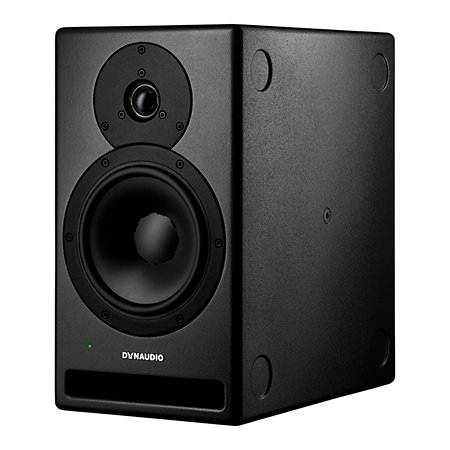
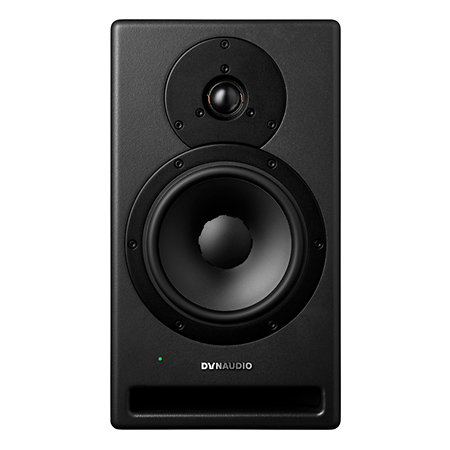
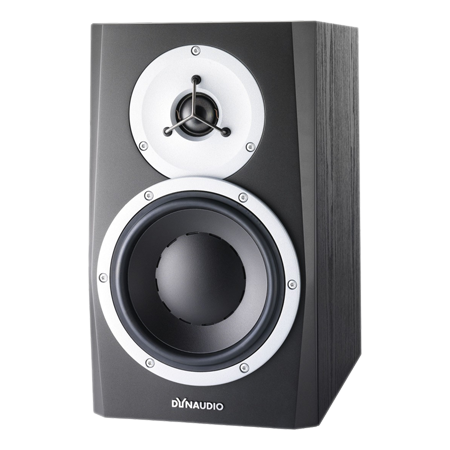
Dynaudio Pro Core 7, active proximity monitor with DSP.
ARTICLE N° 67133
Dynaudio - Core 7
Dynaudio - Core 7
1 457,50 €
excl VAT
including eco-part : 0,90 €
In Stock
Usually ships within 3 days
+infos
Guarantee 3
years
Anais
Tristan
Do you need help?
Presentation
The Core 7 from Dynaudio Pro is a very powerful two-way studio monitor designed to give you the "real" sound, in other words the most neutral sound possible. What you hear is what you record, no more, no less.
The Dynaudio Core 7 further enhances treble reproduction with its all-new Esotar Pro tweeter, featuring the revolutionary Hexis system that optimises airflow, smoothes frequency response and eliminates unwanted internal resonances to deliver exceptional spatiality, detailed transients and natural high-frequency response.
The woofer, responsible for the Core 7's midrange and bass, is also a technological feat, using the patented MSP (magnesium silicate polymer) cone material as well as aluminium voice coils, glass fibre cylinders and advanced magnet designs to produce drivers capable of delivering unprecedented precision and fidelity. The MSP offers the best combination of lightness, rigidity and damping, making it capable of producing deep, accurate bass, but at the same time very natural midrange detail.
The Dynaudio Pro Core 7 is suitable for all types of studio, delivering maximum performance where compact size is desirable. This includes recording and editing studios, control rooms and mobile installations, dubbing studios, etc.
The Dynaudio Core 7 further enhances treble reproduction with its all-new Esotar Pro tweeter, featuring the revolutionary Hexis system that optimises airflow, smoothes frequency response and eliminates unwanted internal resonances to deliver exceptional spatiality, detailed transients and natural high-frequency response.
The woofer, responsible for the Core 7's midrange and bass, is also a technological feat, using the patented MSP (magnesium silicate polymer) cone material as well as aluminium voice coils, glass fibre cylinders and advanced magnet designs to produce drivers capable of delivering unprecedented precision and fidelity. The MSP offers the best combination of lightness, rigidity and damping, making it capable of producing deep, accurate bass, but at the same time very natural midrange detail.
The Dynaudio Pro Core 7 is suitable for all types of studio, delivering maximum performance where compact size is desirable. This includes recording and editing studios, control rooms and mobile installations, dubbing studios, etc.
Other features
-
Dynaudio Pro Core 7
-
Active front-firing bass reflex studio monitor
-
7" woofer
-
High-performance 1" Esotar pro tweeter
-
650 Watt Class D amplifier (500 W for woofer/midrange + 150 Watt for tweeter)
-
Frequency response: 44 Hz to 21 kHz (±3 dB), 38 Hz to 24 kHz (±6 dB)
-
SPL Max : 112 dB @ 1 m in anechoic chamber, 118 dB @ 1 m in semi-anechoic chamber
-
Crossover at 2300 Hz
-
DSP technology to easily adapt the monitor to the listening environment, optimising performance for positioning, sound balance and low-frequency reproduction
-
Max 24-bit/192 kHz converter (depending on input signal)
-
Dimensions: 220 x 370 x 370 mm (WxHxD)
-
Weight: 14 kg
-
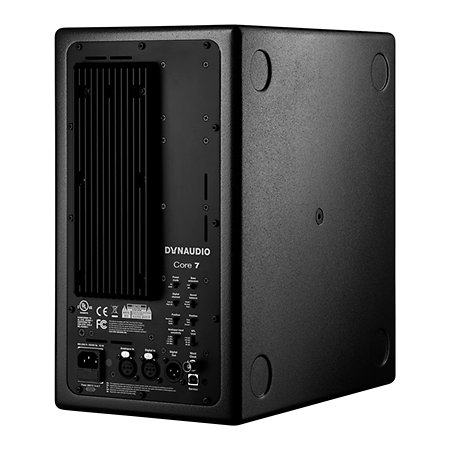
Connections :
-
XLR analogue input
-
AES3 digital input
-
AES digital output
-
Word Clock BNC
-
USB port for service
-
Designed, developed, tested, calibrated and manufactured by hand in Denmark
-
Ideal for multi-channel use, the cores are 0.2dB apart
To find out more...
The DSPs allow you to configure the Dynaudio Core 7 in your studio to solve the problems posed by certain studio environments. Each Core 7 has two DSP filter switches to adapt to the positioning of the loudspeaker and the specifics of each location. For example, if you place the monitors above the VU meters of a large-format mixing console, set them to 'Desk'. This will compensate for the first reflection created by the surface of the console. On the other hand, if you place the monitors in a purpose-built wall, set the Position 1 filter to "Soffit" to compensate for the increased bass response.
Boundary effects created by placing a monitor close to walls or ceilings can be compensated for by setting the Position 2 filter to either 'Wall' or 'Corner'. These filters help to compensate for reflections created by dividing walls, particularly at low frequencies. There is also a low-frequency Linkwitz-Riley filter at 80 Hz that can be activated if you use the Core 7 with a subwoofer to extend the low-frequency response.
Users can also change the overall layout. The Core 7 uses the same concept as the Sound Balance crossover from the LYD series. This is a different design to the typical Shelve equalizer settings for the tweeter and woofer found on most active monitors. Instead of simply lowering or raising the tweeter level, which will affect the phase response, the Core 7 uses a full-spectrum bandpass filter that switches according to the desired tonal response. In the 'Dark' setting, the entire frequency response slopes so that at 20kHz there is an attenuation of -1.5dB, while at 20Hz there is an increase of +1.5dB. In "Bright" mode, the slope is reversed (+ 1.5 dB at 20 kHz and - 1.5 dB at 20 Hz). This slight filter maintains the correct phase response between the loudspeakers while providing the tone that suits you. The changes are subtle, but often this small adjustment is enough to balance the sound perfectly.
Input sensitivity to suit you
The noise floor and signal resolution of any monitoring system are crucial to its performance. Whether you're using analogue or digital inputs, you need to be able to control the gain distribution between the monitor controller and the loudspeaker system. We offer a range of 0dBu to +24dBu to match the sensitivity of the analogue input to the output level. Once optimised, Core 7 processes all analogue signals at 192 kHz sampling rate and 64-bit resolution in the DSP (from the 24-bit analogue-to-digital converter) to achieve the highest degree of mathematical accuracy.
There is a switch to determine the maximum output sound pressure level with the greatest bit depth in the DSP. If you want maximum volume, set it to 112 dB. If you work mainly at lower volumes, choose a lower SPL setting to optimise the bit resolution of the DSP for both inputs.
When using the AES digital inputs, you need to determine which channel (left or right) of the AES stream is being used for this monitor. The Core 7 DSP operates at the incoming sample rate and locks to the digital audio or word clock signal to keep the signal as accurate as possible.
Positioning options: all
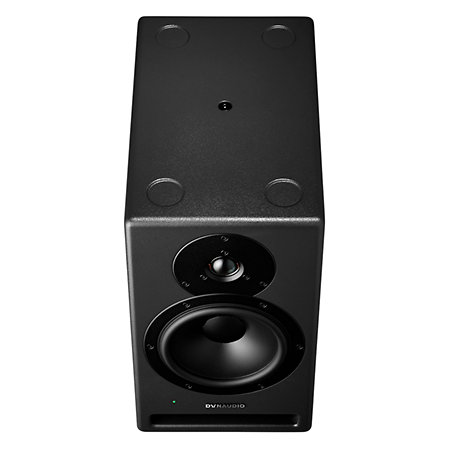
We made sure that the Core 7 enclosure was as rigid and inert as possible; hence the 32mm-thick baffle that contributes to its excellent linearity across the spectrum. Every application is unique, and monitors sometimes have to be placed in a wide variety of environments (on their side, vertically or even inverted with the woofer above the tweeter), so we designed the Core 7 with recesses on all four sides. We've even developed special pads that can be fitted to protect the finish of the enclosure and stabilise it on a surface.
Boundary effects created by placing a monitor close to walls or ceilings can be compensated for by setting the Position 2 filter to either 'Wall' or 'Corner'. These filters help to compensate for reflections created by dividing walls, particularly at low frequencies. There is also a low-frequency Linkwitz-Riley filter at 80 Hz that can be activated if you use the Core 7 with a subwoofer to extend the low-frequency response.
Users can also change the overall layout. The Core 7 uses the same concept as the Sound Balance crossover from the LYD series. This is a different design to the typical Shelve equalizer settings for the tweeter and woofer found on most active monitors. Instead of simply lowering or raising the tweeter level, which will affect the phase response, the Core 7 uses a full-spectrum bandpass filter that switches according to the desired tonal response. In the 'Dark' setting, the entire frequency response slopes so that at 20kHz there is an attenuation of -1.5dB, while at 20Hz there is an increase of +1.5dB. In "Bright" mode, the slope is reversed (+ 1.5 dB at 20 kHz and - 1.5 dB at 20 Hz). This slight filter maintains the correct phase response between the loudspeakers while providing the tone that suits you. The changes are subtle, but often this small adjustment is enough to balance the sound perfectly.
Input sensitivity to suit you
The noise floor and signal resolution of any monitoring system are crucial to its performance. Whether you're using analogue or digital inputs, you need to be able to control the gain distribution between the monitor controller and the loudspeaker system. We offer a range of 0dBu to +24dBu to match the sensitivity of the analogue input to the output level. Once optimised, Core 7 processes all analogue signals at 192 kHz sampling rate and 64-bit resolution in the DSP (from the 24-bit analogue-to-digital converter) to achieve the highest degree of mathematical accuracy.
There is a switch to determine the maximum output sound pressure level with the greatest bit depth in the DSP. If you want maximum volume, set it to 112 dB. If you work mainly at lower volumes, choose a lower SPL setting to optimise the bit resolution of the DSP for both inputs.
When using the AES digital inputs, you need to determine which channel (left or right) of the AES stream is being used for this monitor. The Core 7 DSP operates at the incoming sample rate and locks to the digital audio or word clock signal to keep the signal as accurate as possible.
Positioning options: all
We made sure that the Core 7 enclosure was as rigid and inert as possible; hence the 32mm-thick baffle that contributes to its excellent linearity across the spectrum. Every application is unique, and monitors sometimes have to be placed in a wide variety of environments (on their side, vertically or even inverted with the woofer above the tweeter), so we designed the Core 7 with recesses on all four sides. We've even developed special pads that can be fitted to protect the finish of the enclosure and stabilise it on a surface.
You may also like


Spotlight on

Equivalent products
Tops of the brand

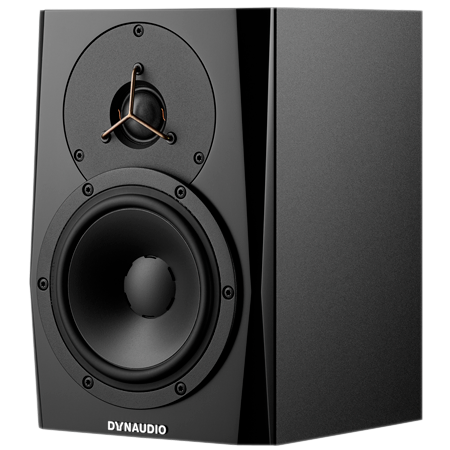

Dynaudio - Core 7
1 457,50 € excl VAT