FILTER

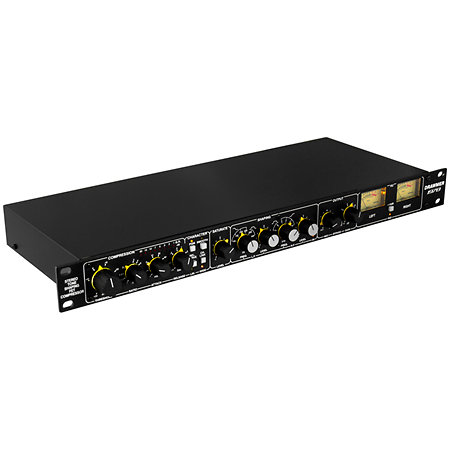
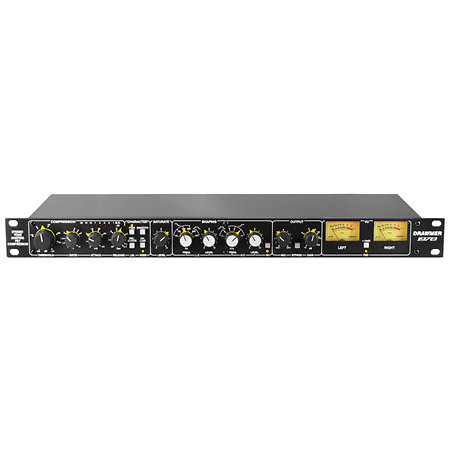
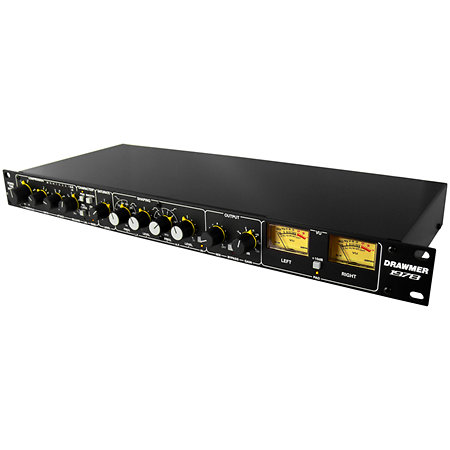
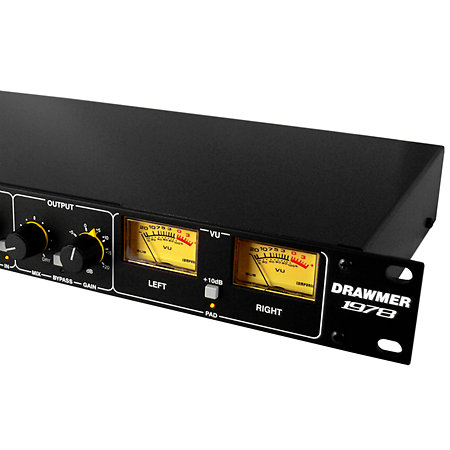
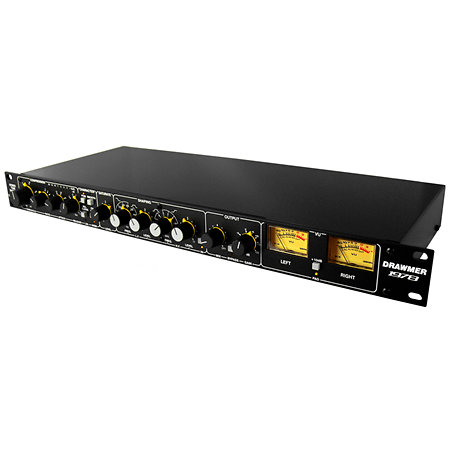


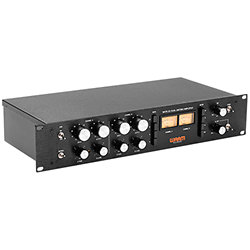
Drawmer - 1978 Stereo Tone Shaping FET Compressor


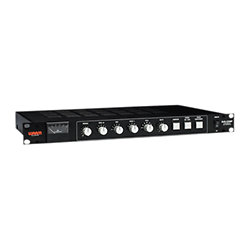
The Drawmer 1978 offers a modern take on the compressor. Its sonic character shifts effortlessly between transparency, harmonic warmth and assertive compression, without becoming difficult to master. A range of controls facilitates a quick approach, keeping the dynamics under control with great finesse. Its built-in parallel processing naturally refines every adjustment and allows the original signal to breathe as required. Once integrated into an audio chain, this unit is almost like a discreet craftsman who polishes the mix without seeking applause.
Presentation
The main controls are intuitive and allow you to achieve a precise result quickly, without requiring numerous adjustments or slowing down the creative process.
The four Character modes alter the compression’s character to produce a range of sonic signatures inspired by classic analogue references. The Saturation control rounds off this suite by adding controlled second- and third-order harmonics, capable of imparting greater density or a warmer texture depending on the context.
This combination allows you to transition from subtle processing to distinctly pronounced colouration without changing devices. The result retains excellent clarity and makes it easy to find the right balance for a wide range of musical productions, from delicate mixes to much more pronounced processing.
The Mix control simplifies parallel compression with a single knob that precisely blends the processed signal and the direct signal. This approach allows you to preserve useful transients whilst enhancing the overall density.
Significant adjustments can thus be precisely controlled, and the result easily gains in naturalness. A situation where the knob sometimes seems to be working almost as hard as the engineer, without needing a coffee break.
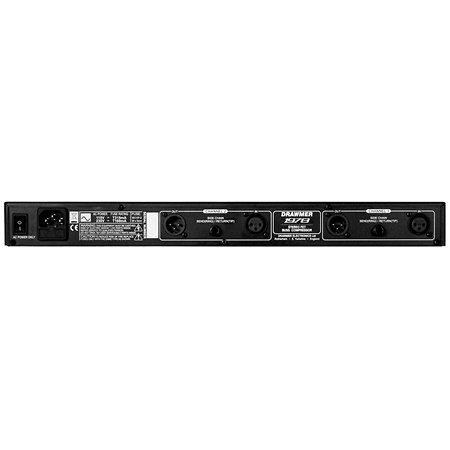
The equalisation of the detection circuit offers particularly advanced control thanks to adjustable low- and high-frequency filters, as well as stereo insert points accessible on the rear panel. This architecture facilitates targeted processing such as sibilance reduction, control of dominant low frequencies, or adapting the compressor’s response to different audio content.
Other features
-
Drawmer 1978
-
Studio equipment
-
Stereo FET compressor
-
Circuitry: Fully analogue
-
Country of manufacture: United Kingdom
-
Channels: 2
-
Compression: Adjustable threshold, ratio, attack and release
-
Character: 4 switchable compression modes
-
Saturation: Variable control of 2nd- and 3rd-order harmonics
-
Mix: Wet/Dry control for parallel compression
-
Side-chain EQ: variable LF & HF filters
-
Side-chain inserts: rear stereo insert points
-
VU meters: dual backlit analogue VU meters
-
Frequency response: 20 Hz ⭢ 20 kHz
-
Distortion: 0.02% THD+N @ 1 kHz, 0 dB
-
Distortion: 0.2% THD+N @ 1 kHz, +10 dB
-
Max. input level: +21 dBu
-
Max. output level: +21 dBu
-
Input impedance: ≥20 kΩ
-
Output impedance: <100 Ω
-
Crosstalk: <-70 dB @ 1 kHz
-
Noise: -88 dB
-
.
-
Connectors:
-
Inputs: 2x XLR
-
Outputs: 2x XLR
-
Low-noise toroidal linear power supply: 115–230 V ∿, 50–60 Hz
-
230 V fuse: T160 mA
-
Standard 19" rack-mount, 1U
-
Dimensions: 482 x 202 x 44 mm
-
Weight: 2.7 kg
To find out more...
In a stereo mixing chain, this analogue compressor can be used to boost a track’s overall presence with a balanced blend of compression and harmonic saturation. The Character modes allow you to explore a range of sonic textures, from subtle correction to more pronounced colouration. The side-chain filters can also help to adjust the processing response to dominant low- or high-frequency elements in a complex signal.
For vocal processing, the 1978 can help to stabilise level variations whilst preserving natural expression. Parallel processing offers a flexible approach to balancing presence and dynamic control. The detection circuit’s adjustment options can also be used to fine-tune the compressor’s response according to pitch range, the recorded take or the desired aesthetic.
In mastering or stereo finalisation, its compressor will play a key role in the final stages of sound balancing thanks to its precise metering, output control and harmonic shaping capabilities.
Its VU metres allow you to quickly monitor the signal’s behaviour, whilst the combination of variable saturation and parallel compression facilitates subtle adjustments designed to preserve the overall dynamics.
Additional documents
You may also like

Spotlight on

Drawmer is
a well-known brand in the PA and studio universe, specialised in signal
processing devices. You are looking for a Noise Gate that does not only cut the
sound, go for the MX40. This quadruple Noise Gate allows an automatic setting
of the attack time and offers the Peak Punch function that adds more impact to
drum and percussive sounds.