FILTER
FILTER

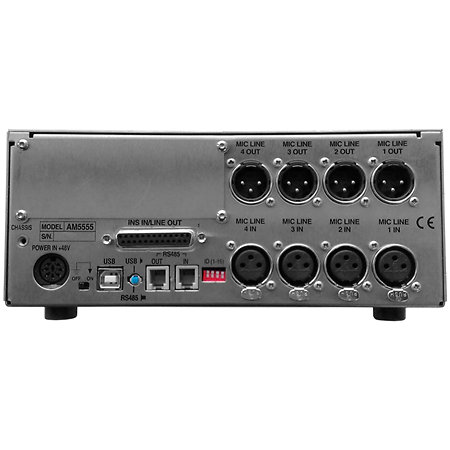


Neve - 4081 Quad Mic Preamp
New
2 973,33 €
excl VAT
Out of stock
Guarantee 3
years

Anais

Tristan
Do you need help?
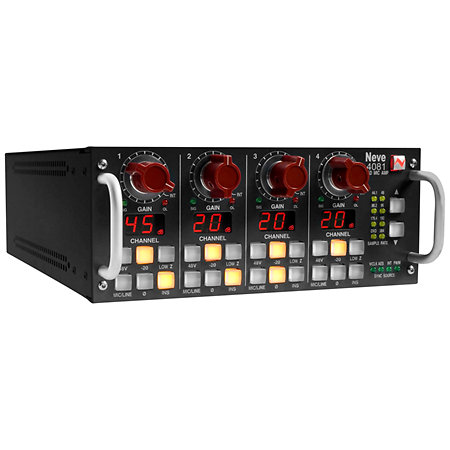
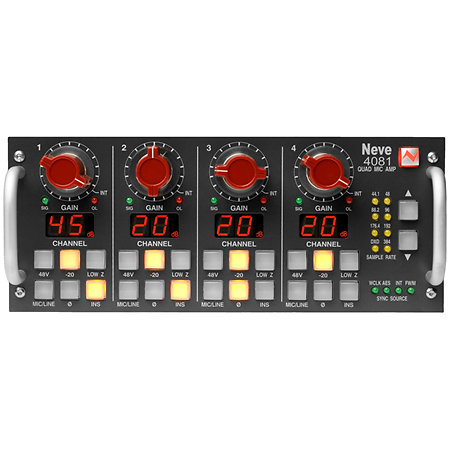
The AMS Neve 4081 is a 4-channel microphone preamp inspired by the legendary 1081 modules, designed to deliver the famous Neve sound with precise, modern control. Its four Class A/B preamps feature 70 dB of gain, a -20 dB pad, phase reversal, low impedance and 48 V phantom power. Remote control and balanced inserts make it an ideal solution for studio, broadcast and live applications.
ARTICLE N° 125851
Neve - 4081 Quad Mic Preamp
Neve - 4081 Quad Mic Preamp
New
2 973,33 €
excl VAT
Out of stock
Guarantee 3
years
Anais
Tristan
Do you need help?
Presentation
The AMS Neve 4081 brings the architecture of the famous 1081 preamplifiers to a four-channel unit designed for professional productions. Each channel benefits from Neve’s expertise and Marinair®-standard transformers, combined with a Class A/B design capable of delivering up to 70 dB of gain. This combination enables detailed and rapid reproduction of transients, which is particularly beneficial for vocals, drums, percussion and recordings requiring precision and presence.
The 4081 also stands out for its versatility. Each XLR input can operate at microphone level or as an electronically balanced line input, with independent gain ranging from 20 to 70 dB in mic mode and from 0 to 20 dB in line mode. A -20 dB pad allows you to manage high-level sources, whilst phase reversal, 48 V phantom power and low-impedance selection provide the essential settings for professional recordings. Gain adjustment is carried out in precise 5 dB steps and is immediately visible on the digital display.
For studio use, the 4081’s real strength lies in its remote control capability. All functions can be controlled from a Mac or PC using the Neve Remote Control software. Several units can be daisy-chained to centralise control of multiple channels, which in particular allows the preamps to be positioned close to the microphones and reduces the length of microphone cables. The manual states that up to 64 independent channels can be managed.
Each channel also features a balanced analogue insert stage located before the A/D conversion. This makes it possible to incorporate an equaliser, a compressor or any other analogue processing prior to digital recording. An optional digital card adds four A/D channels and four D/A channels, with AES/EBU and FireWire, up to 192 kHz and synchronisation via internal clock, AES/EBU or Word Clock.
The 4081 is therefore a particularly suitable solution for recording studios, broadcast facilities, OB vans, post-production studios and live environments that require both the character of Neve preamps and centralised source management.
The 4081 also stands out for its versatility. Each XLR input can operate at microphone level or as an electronically balanced line input, with independent gain ranging from 20 to 70 dB in mic mode and from 0 to 20 dB in line mode. A -20 dB pad allows you to manage high-level sources, whilst phase reversal, 48 V phantom power and low-impedance selection provide the essential settings for professional recordings. Gain adjustment is carried out in precise 5 dB steps and is immediately visible on the digital display.
For studio use, the 4081’s real strength lies in its remote control capability. All functions can be controlled from a Mac or PC using the Neve Remote Control software. Several units can be daisy-chained to centralise control of multiple channels, which in particular allows the preamps to be positioned close to the microphones and reduces the length of microphone cables. The manual states that up to 64 independent channels can be managed.
Each channel also features a balanced analogue insert stage located before the A/D conversion. This makes it possible to incorporate an equaliser, a compressor or any other analogue processing prior to digital recording. An optional digital card adds four A/D channels and four D/A channels, with AES/EBU and FireWire, up to 192 kHz and synchronisation via internal clock, AES/EBU or Word Clock.
The 4081 is therefore a particularly suitable solution for recording studios, broadcast facilities, OB vans, post-production studios and live environments that require both the character of Neve preamps and centralised source management.
Other features
-
AMS Neve 4081
-
Architecture and preamplification:
-
4-channel mic/line preamplifier
-
Four preamplifiers derived from the 1081 family
-
Design: Class A/B
-
Input transformers: Marinair® standard transformers
-
Inputs: 4 × XLR
-
Switchable XLR input: microphone / electronically balanced line
-
Microphone input impedance: 1 kΩ at 1 kHz
-
Line input impedance: 50 kΩ
-
Microphone gain: +20 to +70 dB
-
Microphone gain step: 5 dB
-
Line gain: 0 to +20 dB
-
Line gain step: 5 dB
-
Gain control: endless rotary
-
Display: digital display showing gain value
-
Maximum microphone input level with pad: +24 dB
-
Pad: -20 dB
-
Phantom power: 48 V, switchable
-
Phase reversal: yes
-
LOW Z: yes, specifically designed for ribbon microphones
-
Signal presence indicator: green LED, approximately -30 dBu or higher
-
Overload indicator: red LED, 2 dB below clipping
-
LED measurement point: after the gain stage
-
Maximum signal level: +26 dBu
-
Outputs: maximum level +26 dBu into 600 Ω
-
Output impedance: 50 Ω ±5% at 1 kHz
-
Outputs: balanced
-
Distortion: <0.07% at an output of 20 dBm, from 50 Hz to 10 kHz, at 60 dB of gain
-
Equivalent input noise: > -123 dBm, 20 Hz–20 kHz, at 60 dB gain
-
Control and workflow:
-
Front-panel control
-
Remote control via Mac or PC
-
Neve Remote Control software
-
Control possible via Pro Tools with the appropriate configuration
-
Saving and recalling configurations
-
Automatic recall of settings, levels and states as they were at the last shutdown
-
Daisy-chaining of multiple 4081 units via USB / RS485
-
Up to 64 independent channels that can be controlled from a single point, according to AMS Neve
-
Option to position the preamps remotely, as close as possible to the microphones
-
Each channel retains its own microphone and line gain settings separately when switching modes
-
Inserts and analogue connectivity:
-
1 balanced analogue insert per channel
-
Insert positioned before A/D conversion when the optional digital card is installed
-
Allows external equipment such as equalisers or compressors to be inserted
-
XLR outputs can be used as direct outputs or insert sends
-
XLR outputs positioned after the gain control
-
25-pin D-sub INS IN / LINE OUT connector for insert returns and line outputs
-
The D-sub line outputs only function when the optional AD/DA card is installed
-
Optional digital conversion:
-
Optional AD/DA / FireWire card
-
4 A/D channels
-
4 D/A channels
-
AES/EBU digital interface
-
FireWire interface
-
2 FireWire ports
-
25-pin D-sub AES IN/OUT connector
-
2 stereo AES/EBU ports for the four A/D channels
-
Up to 192 kHz
-
192 kHz operation with true single-wire stereo transmission
-
4 D/A channels suitable for monitoring, artist monitors or connection to analogue equipment
-
Synchronisation via Internal, AES/EBU or Word Clock
-
Word Clock input and output on the optional card
-
In FireWire mode, the four A/D channels can also be routed simultaneously to both AES/EBU ports
-
The card can be retrofitted into an existing 4081
-
Mounting and power supply:
-
Dimensions of the unit alone: 8.5" wide (half a 19" rack unit)
-
Two 4081 units can be combined to form an 8-channel system, and 19" rack mounting is possible with the optional mounting kit
-
2 × 4081 configuration: 2U / 19"
-
External power supply
-
Mains voltage: 100–240 V AC
-
Frequency: 50–60 Hz
-
Maximum rated current: 1.9 A
-
Internal power supply for the 4081: 48 V DC
-
Internal fuse: 1 A, 20 × 5 mm type
-
Dimensions and weight:
-
Width: 218 mm / 8.5"
-
Height: 88.2 mm / 3.5" (2U)
-
Depth: 267 mm / 10.5"
-
Net weight: 3.16 kg / 7 lb
To find out more...
- The LOW Z is not simply a ‘generic’ impedance setting: AMS Neve has designed it specifically for ribbon microphones. It is therefore a setting that should be utilised when recording with ribbon microphones, rather than being left switched off as a matter of course.
- The 4081 is particularly useful for remote recording: by daisy-chaining several units and controlling them via the software, you can position the preamps closer to the microphones to reduce the length of the microphone cables, whilst retaining control from the control room.
- Take care with AES cabling: the 4081’s 25-pin D-sub AES connector follows the Tascam AES convention. A standard analogue D-sub breakout cable is not suitable: the AES pinout crosses the connections. This is an important detail to bear in mind when integrating the digital card.
- The digital card is retrofittable: it can be ordered with the 4081 or added at a later date, allowing you to start with analogue and then expand the unit as the studio’s needs evolve.
- The 4081 is particularly useful for remote recording: by daisy-chaining several units and controlling them via the software, you can position the preamps closer to the microphones to reduce the length of the microphone cables, whilst retaining control from the control room.
- Take care with AES cabling: the 4081’s 25-pin D-sub AES connector follows the Tascam AES convention. A standard analogue D-sub breakout cable is not suitable: the AES pinout crosses the connections. This is an important detail to bear in mind when integrating the digital card.
- The digital card is retrofittable: it can be ordered with the 4081 or added at a later date, allowing you to start with analogue and then expand the unit as the studio’s needs evolve.