
FILTER
FILTER



Axel Technology - Oxygen 2000
New
3 565 €
excl VAT
Out of stock
Guarantee 3
years

Louis
Do you need help?
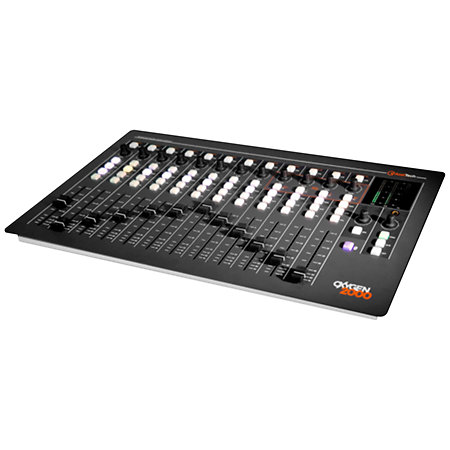
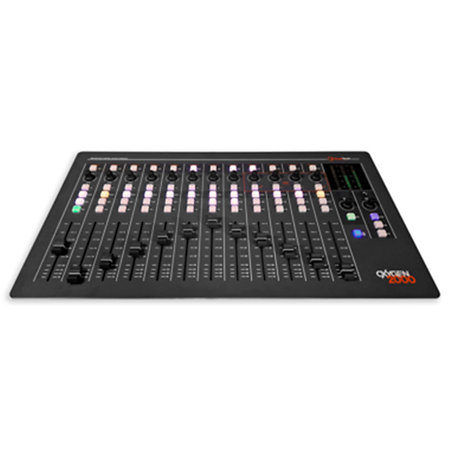
The Axel Technology Oxygen 2000 is a 12-fader digital broadcast console designed to handle both live broadcasts and radio productions. With its 5 microphone inputs, Automix, telephone functions, Bluetooth, USB and numerous routing options, it allows presenters, guests, music sources and calls to be managed from a single interface.
ARTICLE N° 126699
Axel Technology - Oxygen 2000
Axel Technology - Oxygen 2000
New
3 565 €
excl VAT
Out of stock
Guarantee 3
years
Louis
Do you need help?
Presentation
A radio programme involves more than just turning faders up or down. Between the presenters’ voices, studio guests, jingles, music, phone calls, external contributions and various audio destinations, the mixing desk must be capable of handling a workflow that can sometimes be very demanding without complicating the technician’s tasks. It is with this in mind that Axel Technology’s Oxygen 2000 combines a compact control surface with fully digital audio processing and a particularly comprehensive routing architecture.
Its 12 faders allow the main sources in a radio control room to be organised whilst maintaining direct access to essential controls. Each channel strip features quick A/B source selection, whilst the PGM, SUB, AUX 1, AUX 2 and PFL buses allow the various production and monitoring paths to be separated. The advertised latency of less than 0.7 ms between input and output helps to maintain a sense of immediate responsiveness, particularly during live broadcasts.
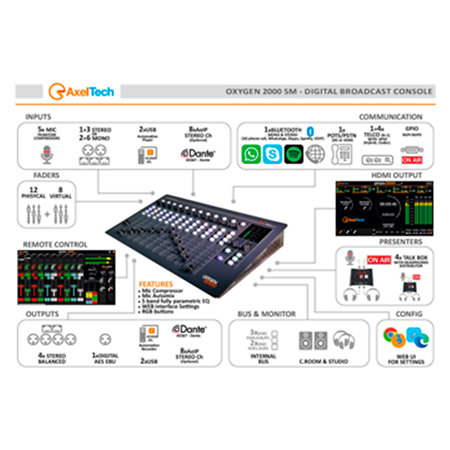
One of the Oxygen 2000’s key strengths lies in its dedicated microphone functions. The five microphone inputs feature dynamic processing comprising a parametric equaliser, compressor and expander, with 48 V phantom power. The Automix function goes a step further by automatically grouping active microphones into a dedicated source. When a programme features several speakers, the system can automatically mute unused microphones, adjust levels and apply final compression to achieve a more consistent overall sound. The presenter can therefore focus on the programme without having to constantly monitor each channel.
The console also incorporates a telephone hybrid and several Telco options. An analogue telephone line can be connected directly to the console, whilst an N-1 connection allows an external hybrid to be integrated. Bluetooth offers another particularly useful feature for modern broadcasts: calls from a smartphone or wireless transmission of a stereo audio stream. In call mode, the PFL allows for a private conversation before bringing the caller on air.
For music playback and production, the Oxygen 2000 features three analogue stereo inputs, balanced analogue outputs, an AES/EBU output and two USB audio interfaces. These allow a computer to be connected directly to the console, enabling simultaneous playback and recording without the need for an external sound card. A Dante-equipped version can also significantly expand the possibilities for networked audio transmission, with 8 additional stereo inputs and 8 additional stereo outputs.
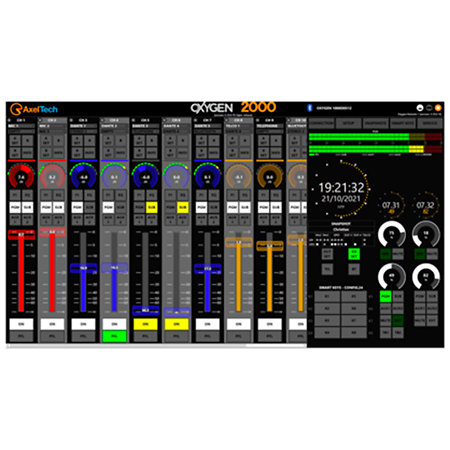
Operation is not limited to the physical console. The Oxygen Remote software replicates the console’s main functions on a computer and, in particular, allows multiple consoles to be controlled from a single environment. The HDMI output, meanwhile, can feed an external screen displaying levels, buses, A/B sources, On Air information, timers and the clock. It can also be used as a configuration interface.
Its 12 faders allow the main sources in a radio control room to be organised whilst maintaining direct access to essential controls. Each channel strip features quick A/B source selection, whilst the PGM, SUB, AUX 1, AUX 2 and PFL buses allow the various production and monitoring paths to be separated. The advertised latency of less than 0.7 ms between input and output helps to maintain a sense of immediate responsiveness, particularly during live broadcasts.
One of the Oxygen 2000’s key strengths lies in its dedicated microphone functions. The five microphone inputs feature dynamic processing comprising a parametric equaliser, compressor and expander, with 48 V phantom power. The Automix function goes a step further by automatically grouping active microphones into a dedicated source. When a programme features several speakers, the system can automatically mute unused microphones, adjust levels and apply final compression to achieve a more consistent overall sound. The presenter can therefore focus on the programme without having to constantly monitor each channel.
The console also incorporates a telephone hybrid and several Telco options. An analogue telephone line can be connected directly to the console, whilst an N-1 connection allows an external hybrid to be integrated. Bluetooth offers another particularly useful feature for modern broadcasts: calls from a smartphone or wireless transmission of a stereo audio stream. In call mode, the PFL allows for a private conversation before bringing the caller on air.
For music playback and production, the Oxygen 2000 features three analogue stereo inputs, balanced analogue outputs, an AES/EBU output and two USB audio interfaces. These allow a computer to be connected directly to the console, enabling simultaneous playback and recording without the need for an external sound card. A Dante-equipped version can also significantly expand the possibilities for networked audio transmission, with 8 additional stereo inputs and 8 additional stereo outputs.
Operation is not limited to the physical console. The Oxygen Remote software replicates the console’s main functions on a computer and, in particular, allows multiple consoles to be controlled from a single environment. The HDMI output, meanwhile, can feed an external screen displaying levels, buses, A/B sources, On Air information, timers and the clock. It can also be used as a configuration interface.
Features
Number of ways
12
Motorized faders
Yes
Audio interface
USB
DAW MIDI Control
Yes
Stereo line input
4
Micro input
5
Digital input
RJ45
Digital output
RJ45
Headphone output
2
Output channels
6
Media player
USB
Recording medium
USB
USB port
Yes
Weight
7,1 kg
Power supply
220 V
Input channels
12
Connectors
XLR male 3 pins, XLR female 3 pins, RJ45, Jack female Stéréo, HDMI
Packaging
Single unit
Other features
-
Axel Technology Oxygen 2000
-
Digital broadcast mixing console
-
Model number: AX-OXY2K-BT
-
Number of faders: 12
-
Architecture: fully digital audio processing
-
Buses: PGM, SUB, AUX 1, AUX 2, PFL
-
Quick selection: A/B buttons on each fader
-
Microphone inputs: 5, with Automix
-
Microphone input 1: balanced XLR
-
Microphone inputs 2 to 5: balanced RJ45
-
Phantom power: +48 V
-
Microphone processing: 5-band parametric equaliser, compressor, expander, AutoFader and Ducking
-
Automix: automatic management of levels and attenuation of unused microphones
-
Stereo analogue inputs: 3, or 4 with 3-microphone configuration
-
Line input connectors: balanced XLR and RJ45
-
Line input modes: Stereo, Mono, L, R, INV-L, INV-R, INV
-
Telephone hybrid: 1 built-in, POTS/PSTN line via RJ11
-
Telco interface: 1 N-1 input/output via RJ45
-
Additional Telco channels: up to 4 depending on configuration
-
Bluetooth: bidirectional for calls, unidirectional stereo A2DP
-
USB audio: 2 USB Type-B stereo interfaces
-
USB audio: 1 stereo playback channel and 1 stereo recording channel per interface
-
Analogue outputs: 4 balanced
-
OUT-1 output: XLR, PGM
-
OUT-2 output: XLR, SUB by default, configurable as N-1
-
OUT-3 and OUT-4 outputs: RJ45, AUX 1 and AUX 2 by default
-
Digital output: AES/EBU via XLR
-
Audio networking option: Dante, 8 stereo inputs and 8 stereo outputs
-
Audio sampling rate: 48 kHz
-
A/D conversion: 24-bit / 48 kHz
-
D/A conversion: 24-bit / 48 kHz
-
Signal-to-noise ratio (line inputs): >100 dB
-
Signal-to-noise ratio (microphone inputs): >90 dB
-
THD+N (line inputs): <0.002%
-
THD+N for microphone inputs: <0.01%
-
Frequency response for line inputs: ±0.5 dB from 20 Hz to 20 kHz
-
Microphone gain: 0 to +57 dB, in 3 dB steps
-
Nominal microphone input level: -9 to -66 dBu
-
Maximum microphone input level: +9 dBu
-
Nominal line input level: 0 dBu
-
Maximum line input level: +18 dBu
-
Nominal output level: 0 dBu
-
Maximum output level: +18 dBu
-
Headphone outputs: 6.35 mm jack outputs for the control room, configurable outputs for the studio
-
Monitor control: independent source selection, levels and attenuation
-
PFL: private listening and talkback on Hybrid, Telco and Bluetooth functions
-
GPI: 9 inputs depending on configuration
-
GPO: 9 outputs depending on configuration
-
GPIO controls: Talkback, Telephone, Ring, Hook, On Air and custom functions
-
Network connectivity: RJ45, 100 Mbit/s
-
Remote control: Oxygen Remoter
-
Remote configuration: web interface
-
Backup: internal microSD memory, USB or computer via web interface
-
Snapshots: 10 surface configurations
-
EQ presets: up to 10
-
Updates: firmware via the internet
-
HDMI output: display of levels, buses, sources, On Air status, timers and clock
-
HDMI display: configuration interface with rotary controls
-
Audio DSP: Analog Devices ADAU1452, 32-bit, 294 MHz
-
System processor: Allwinner A20 dual-core Cortex-A7, 800 MHz
-
System memory: 1 GB RAM
-
Nominal latency from analogue input to analogue output: 0.7 ms
-
Communication ports: 2 × USB-A, 2 × USB-B, 1 × LAN, 1 × HDMI
-
Power supply: 90 to 260 V AC, 47 to 63 Hz
-
Power consumption: 30 W
-
Operating temperature: 0 to 40 °C
-
Dimensions: 614 × 80 × 343 mm
-
Weight: 7.1 kg
You may also like



Spotlight on

Equivalent products

Axel Technology - Oxygen 2000
3 565 € excl VAT