
FILTER
FILTER




Death By Audio - Robot Harmonizer
275,83 €
excl VAT
including eco-part : 0,90 €
Out of stock
Guarantee 3
years

Fred

Eric
Do you need help?
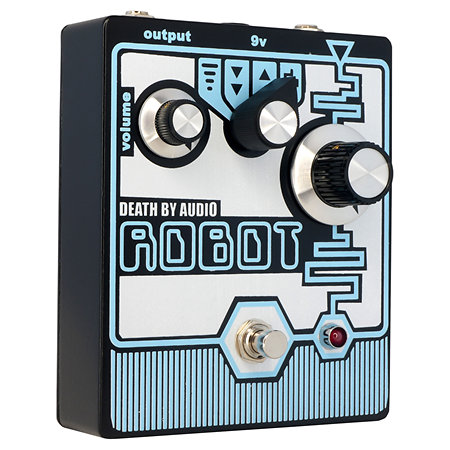
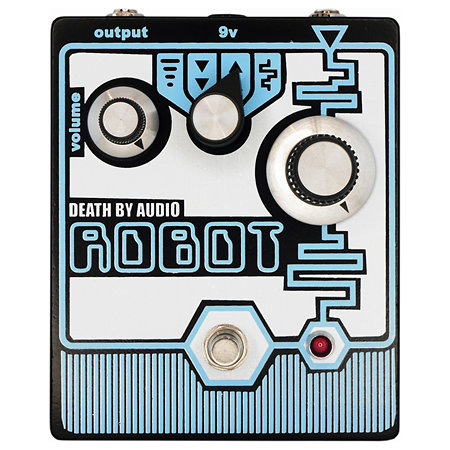
The Robot is a completely synthetic 8-bit lo-fi pitch shifter that transforms any input into a mash-up of resynthesised robotic jargon. It features super lo-fi fuzz, octave up, octave down and arpeggios.
ARTICLE N° 83355
Death By Audio - Robot Harmonizer
Death By Audio - Robot Harmonizer
275,83 €
excl VAT
including eco-part : 0,90 €
Out of stock
Guarantee 3
years
Fred
Eric
Do you need help?
Presentation
All modes are controlled by a single control pot, which defines the frequency at which the chip operates, modifying and distorting the effects of pitch change and aliasing.
Other features
-
Death By Audio Robot
-
Effect pedal for electric guitar
-
Type : Harmonizer
-
Controls : Volume, switch mode (4 positions), control
-
Connections :
-
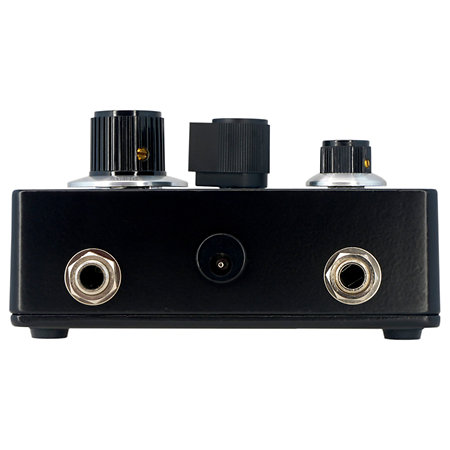
Input: 6.35 mm mono jack
-
Output : 6.35 mm mono jack
-
Send / Return: 2 x 6.35 mm jack
-
Power supply: 9V battery supplied, or 9V adapter sold separately
-
Power connector: 2.1 x 5.5 mm cylindrical plug, negative centre (standard 9 V)
-
Dimensions: 196 x 119 x 59 mm
-
Weight: 595 g
To find out more...
What are the Robot controls used for?
- Volume: controls the master volume.
- Control potentiometer: located on the right-hand side of the pedal. Controls the pitch of the effect. When turned fully clockwise, it is at its highest pitch. Turning it counter-clockwise decreases the pitch or speed of the arpeggiator.
- Rotary switch :
- Normal: same step with 8-bit digital conversion when the control knob is fully clockwise. Turning the control knob downwards lowers the pitch.
- Octave down: turning the knob fully clockwise produces an unpleasant octave-down sound. Turning the control knob downwards lowers the pitch further.
- Octave up: turning the knob fully clockwise produces an unpleasant octave-up sound. Turning the knob down lowers the pitch.
- Arpeggiator: the pitch is arpeggiated in a sequence. The control knob adjusts the speed of the arpeggiator.
- Volume: controls the master volume.
- Control potentiometer: located on the right-hand side of the pedal. Controls the pitch of the effect. When turned fully clockwise, it is at its highest pitch. Turning it counter-clockwise decreases the pitch or speed of the arpeggiator.
- Rotary switch :
- Normal: same step with 8-bit digital conversion when the control knob is fully clockwise. Turning the control knob downwards lowers the pitch.
- Octave down: turning the knob fully clockwise produces an unpleasant octave-down sound. Turning the control knob downwards lowers the pitch further.
- Octave up: turning the knob fully clockwise produces an unpleasant octave-up sound. Turning the knob down lowers the pitch.
- Arpeggiator: the pitch is arpeggiated in a sequence. The control knob adjusts the speed of the arpeggiator.
Videos
You may also like





Spotlight on

Equivalent products

Tops of the brand
Death By Audio - Robot Harmonizer
275,83 € excl VAT