FILTER

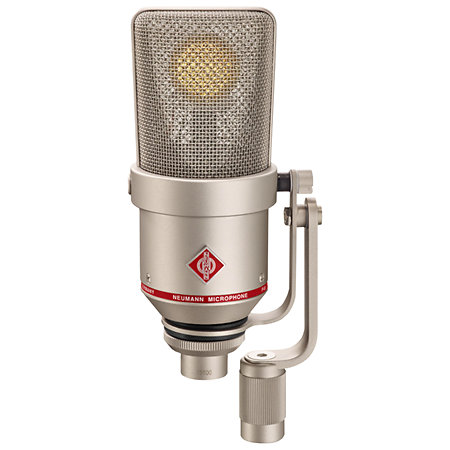


Neumann - TLM 170 R


A large-diaphragm microphone with extremely low self-noise and an impressive dynamic range, to enhance its impressively versatile capabilities, the TLM 170 R has several polar patterns (omnidirectional / wide cardioid / cardioid / hypercardioid / bidirectional).
Presentation
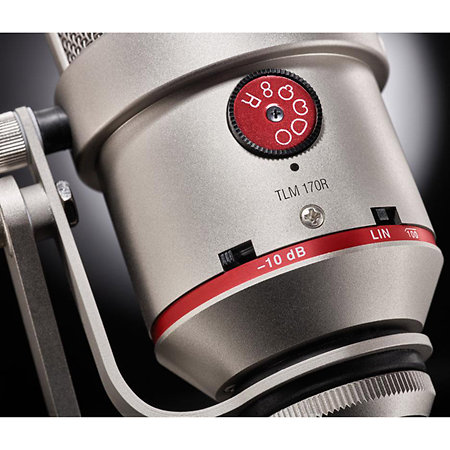
Its five polar patterns can be selected via a rotary selector. In the sixth position, marked "R", the directionality is controlled remotely from the N 248 power supply. No special cable is required in this case.
Other features
-
Neumann TLM 170 R
-
Studio microphone
-
Pressure gradient transducer
-
Polar patterns: omnidirectional / wide cardioid / cardioid / hypercardioid / bidirectional (figure-8)
-
Frequency response: 20 Hz - 20 kHz
-
Sensitivity at 1 kHz, load 1 kOhm: 8 mV/Pa
-
Nominal output impedance: 50 Ohms
-
Recommended load impedance: 1 kOhm
-
Input noise level: 26 dB
-
Input noise level: 14 dB (A)
-
Signal-to-noise ratio: 68 dB
-
Signal-to-noise ratio: 80 dB
-
Maximum SPL: 144 dB
-
Maximum SPL with pre-attenuator activated: 154 dB
-
Maximum output level: +10 dBu
-
Built-in mic preamp dynamic range: 130 dB
-
Phantom power supply voltage 48 V ± 4 V
-
Current consumption: 3 mA
-
Connections: XLR
-
Finish: Nickel-plated
-
Dimensions: 60 x 60 x 152 mm
-
Weight: 625 g
To find out more...
Applications
The TLM 170 R condenser microphone is a large-diaphragm model with several polar patterns. Its sound is highly transparent, unlike some of our other models, which have a distinct personality.
As a result, this microphone is used in a wide variety of applications, in professional recording studios, in broadcast, cinema and television, and for semi-professional productions. The polar pattern can be selected either at the microphone itself, or remotely from the N 248 specific power supply.
Acoustic characteristics
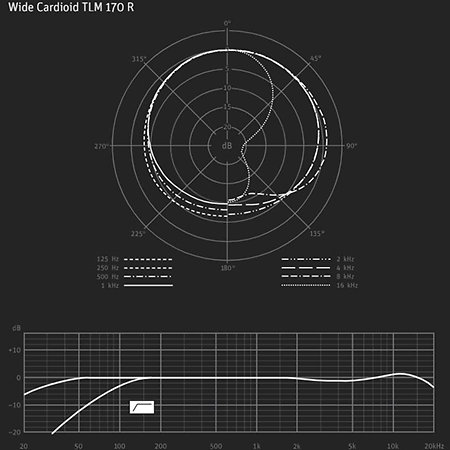
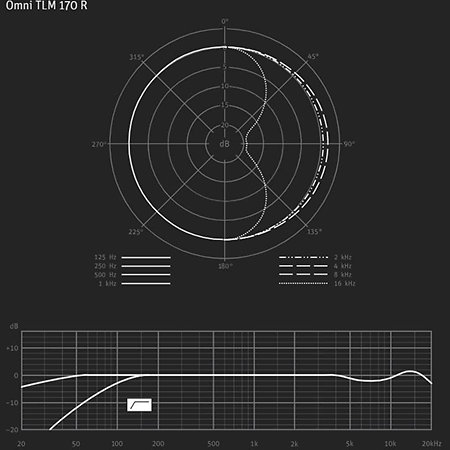
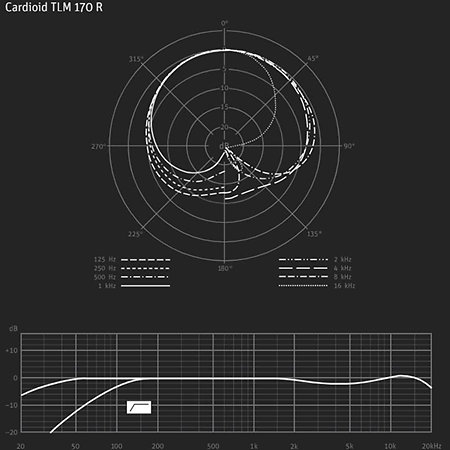
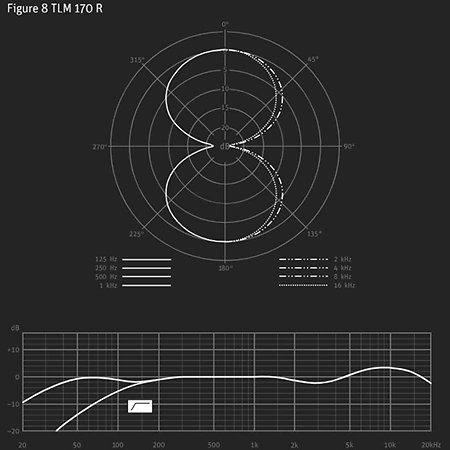
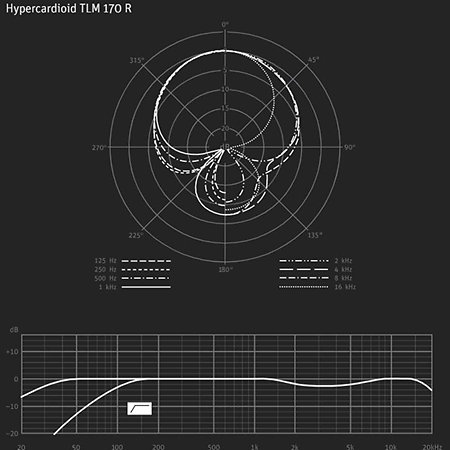
The microphone is side-incident - the Neumann logo faces the sound source. The large-diaphragm capsule, sheltered by the grille, has a very flat response curve for all polar patterns, over a fairly wide angle of incidence. The curves are flat and parallel to the curve for 0° incidence, up to 10 kHz, for an angle of incidence of ± 100°.
As a practical consequence, the TLM 170 R has a very regular diffuse-field response, for all polar patterns. This is an important factor in a reverberant environment, since reflections arriving at the microphone come from all directions. Once picked up by the microphone, the tonal quality (spectrum) of the acoustic information is unaffected. This characteristic is achieved without recourse to corrective resonance effects.
As a result, the microphone provides an excellent impulse response for both music and speech, without any coloration. The capsule is flexibly mounted to avoid any transmission of solid-borne noise.
Polar patterns
In addition to the usual polar patterns (omnidirectional, cardioid and bidirectional [Figure 8]), the TLM 170 features hypercardioid and wide cardioid polar patterns. Compared with cardioid, the hypercardioid pattern attenuates sounds coming from the sides more effectively. As for wide cardioid, it is very practical for recording sound sources spread over a certain aperture.
Remote control
The N 248 remote control allows the directivity to be remotely controlled by varying the nominal 48-volt value by ± 3 V (according to the DIN standard, a tolerance of ± 4 V is permitted).
When its rotary directivity selector is in position R (for Remote control), the TLM 170 R measures the value of the phantom voltage it receives and selects the corresponding directivity. It uses a standard microphone cable and XLR 3-pin connector, and the link length can be up to 300 m.
Electrical characteristics
The letters TLM stand for "TransformerLess Microphone". This technology replaces the traditional output transformer with an electronic circuit, providing effective common-mode rejection and avoiding any RF interference that might pollute the balanced audio signal.
Use on tripods
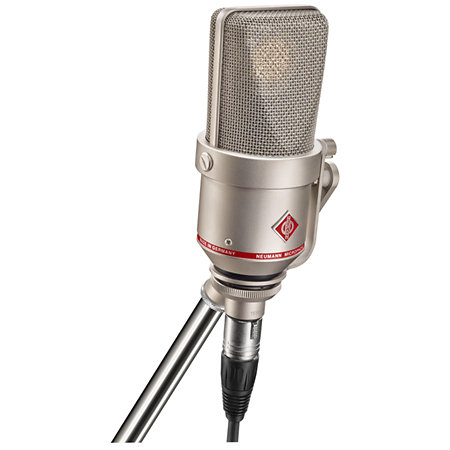
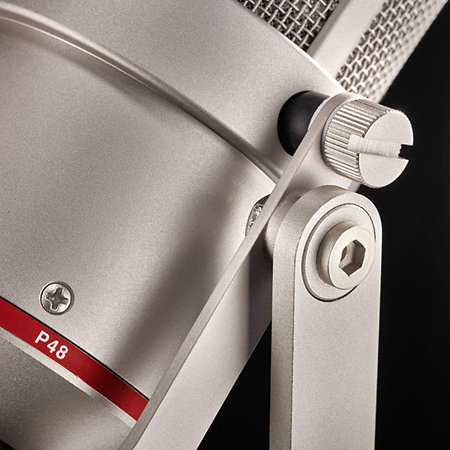
The TLM 170 R is supplied with a tilting side-mount, allowing the microphone to be attached to poles or stands. This bracket has rubber elements that effectively protect the microphone from mechanical shock. If required, it can be mounted on the other side of the microphone.
If you are using the IC 4 cable (for example, to suspend the microphone from the ceiling with the MNV 87 auditorium support), you need to dismantle the bracket and its support. You can then connect the microphone to the swivel connector at the end of the cable.
Filter and attenuation
The TLM 170 R microphone has a switchable 10 dB attenuator to prevent overloading the device that follows it in the signal chain. A second switch at the rear of the microphone attenuates frequencies below 100 Hz, to suppress unwanted vibrations transmitted through solid-borne sound.
Safety and reliability
All exposed surfaces of the capsule, including the diaphragms, are at ground potential. This technology makes them immune to electrical and atmospheric interference, as well as contamination by microscopic particles and dust.
You may also like


Spotlight on

A legendary brand for decades, present in all the major recording studios, Neumann is a guarantee of high quality and professionalism. The Beatles, Natalie Cole, Celine Dion, Bryan Adams and Beyoncé... all use this exceptional brand with the famous U87, and the TLM49 at the top of the list. In home studio, the TLM103 and TLM102 condenser microphones are the most popular. For studio sound on stage opt for the KMS105. In recent years, Neumann has also offered the high-end KH80, KH120 and KH310 monitors.