FILTER
FILTER



UVI - Synth Anthology 5
New
124,17 €
excl VAT
In Stock
Usually ships within 24h
+infos

Anais

Tristan
Do you need help?
Synth Anthology 5 brings together the sonic character of 300 hardware synthesisers – from classic analogue models to modern digital machines – within a single virtual instrument. Its 6,000+ layers allow you to quickly create basses, leads, pads, sequences, textures and experimental sounds. The two-layer engine, the new Ladder and VCF 4023 filters, Analog Drift, effects and MPE support make it a versatile tool for producers, composers and sound designers. Downloadable licence.
ARTICLE N° 127428
UVI - Synth Anthology 5
UVI - Synth Anthology 5
New
124,17 €
excl VAT
In Stock
Usually ships within 24h
+infos
Anais
Tristan
Do you need help?
Presentation
UVI Synth Anthology 5: 300 hardware synthesisers brought together in a single virtual instrument
Synth Anthology 5 offers a comprehensive exploration of the history of the synthesiser by bringing together the sounds of 300 hardware machines, both vintage and modern, within a single interface. UVI covers a wide range of technologies and soundscapes: classic and modern analogue synthesis, analogue modelling, FM and formant synthesis, wavetable and digital synthesis, vector synthesis, PCM and sampling.
For producers and composers, the benefit lies in having access to a vast variety of timbres without having to use multiple virtual instruments. The library comprises 54,503 samples, 6,278 presets and over 6,000 sound layers, allowing you to switch quickly from an analogue bass to a lead, a pad, a sequence, a texture or an experimental sound.
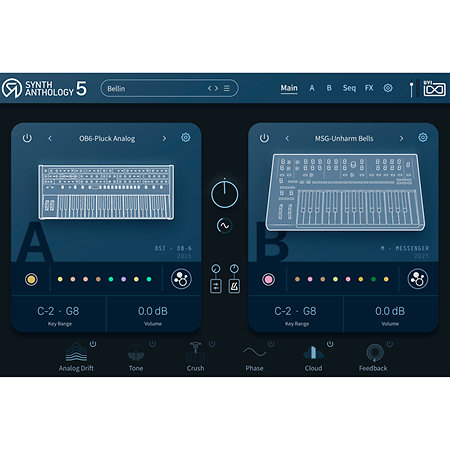
Each preset can be customised using the dual-layer engine, which allows you to layer two independent sound sources and control their balance using a crossfader, amongst other things. Each layer has its own settings for volume, pan, envelopes, filter, pitch, play mode, unison and effects.
The fifth generation adds 100 new synthesisers, over 1,000 new layers, over 16,000 samples and over 300 creative presets. It also introduces the modelled Ladder and VCF 4023 analogue filters, as well as Analog Drift, which allows you to deliberately add pitch and timing variations to recreate some of the imperfect character of analogue instruments.
The modulation system comprises two LFOs and two step modulators, whilst the dual arpeggiator/phraser allows you to programme sequences of up to 16 steps with control over velocity, pitch, octave, gate, panning and repeats. Native MPE support also provides expressive control tailored to compatible keyboards and controllers.
Synth Anthology 5 is therefore equally suited to electronic music production, pop, film scores, sound design and the creation of sound textures.
Synth Anthology 5 offers a comprehensive exploration of the history of the synthesiser by bringing together the sounds of 300 hardware machines, both vintage and modern, within a single interface. UVI covers a wide range of technologies and soundscapes: classic and modern analogue synthesis, analogue modelling, FM and formant synthesis, wavetable and digital synthesis, vector synthesis, PCM and sampling.
For producers and composers, the benefit lies in having access to a vast variety of timbres without having to use multiple virtual instruments. The library comprises 54,503 samples, 6,278 presets and over 6,000 sound layers, allowing you to switch quickly from an analogue bass to a lead, a pad, a sequence, a texture or an experimental sound.
Each preset can be customised using the dual-layer engine, which allows you to layer two independent sound sources and control their balance using a crossfader, amongst other things. Each layer has its own settings for volume, pan, envelopes, filter, pitch, play mode, unison and effects.
The fifth generation adds 100 new synthesisers, over 1,000 new layers, over 16,000 samples and over 300 creative presets. It also introduces the modelled Ladder and VCF 4023 analogue filters, as well as Analog Drift, which allows you to deliberately add pitch and timing variations to recreate some of the imperfect character of analogue instruments.
The modulation system comprises two LFOs and two step modulators, whilst the dual arpeggiator/phraser allows you to programme sequences of up to 16 steps with control over velocity, pitch, octave, gate, panning and repeats. Native MPE support also provides expressive control tailored to compatible keyboards and controllers.
Synth Anthology 5 is therefore equally suited to electronic music production, pop, film scores, sound design and the creation of sound textures.
Features
AAX Native
Yes
Audio units
Yes
Autonomous
Yes
VST2
Yes
VST3
Yes
Compatibility
Windows, MacOS
Updates and upgrades
No
Country of production
France
Packaging
Download License
Other features
-
UVI Synth Anthology 5
-
Download licence: you will receive your serial number by email, along with the invoice
-
UVI virtual instrument / sound library
-
300 hardware synthesisers brought together in this collection
-
Over 6,000 sound layers
-
6,278 presets
-
54,503 samples
-
Library size: 28.45 GB in lossless FLAC format
-
Size specified by UVI in WAV format: approximately 55 GB
-
Sample resolution: 44.1 kHz
-
Source recordings at 88.2 kHz
-
The sounds were programmed, auditioned, recorded and edited by the UVI team.
-
100 new synthesisers added in version 5
-
Over 1,000 new layers
-
Over 16,000 new samples
-
Over 300 new creative presets
-
Synthesis types and instrument families:
-
Classic & modern analogue synthesis
-
Analogue modelling
-
FM and formant synthesis
-
Wavetable and digital synthesis
-
Vector & additive synthesis
-
PCM synthesisers
-
Samplers
-
Instruments covering different generations of vintage and modern synthesisers
-
The official list includes, amongst others, instruments associated with Access, Akai, Alesis, ARP, Arturia, Behringer, Casio, Clavia, Crumar, DSI, E-MU, Kawai, Korg, Kurzweil, Moog, Novation, Oberheim, PPG, Roland/RLD, Sequential/SEQ, Waldorf, Yamaha and many other manufacturers or models
-
Dual-layer sound architecture: Layer A and Layer B
-
Each layer can be edited individually
-
Overlay of two sound sources
-
Crossfader between the two layers
-
Crossfader modulation
-
Crossfader modulation waveforms: sine, triangle, square, saw
-
Modulation synchronised to the host’s tempo
-
Independent keyboard range for each layer
-
Independent volume control for each layer
-
Layer volume: 0 to 4×
-
Autoload function
-
Function to copy parameters from one layer to another
-
Randomisation / random selection of a layer
-
Compatibility and configuration:
-
Works with UVI Workstation 4.0.6 or later (compatible versions)
-
Works with Falcon 26.0.4 or later (compatible versions)
-
Free iLok account required
-
Physical iLok dongle not required
-
Internet connection required for licence activation
-
3 activations per licence, across any combination of computers and/or iLok dongles
-
macOS: 10.14 Mojave to macOS 26 Tahoe
-
Windows: Windows 10 to Windows 11, 64-bit
-
RAM: 4 GB minimum (8 GB minimum recommended by SonoVente.com)
-
Disk space required: 21 GB
-
7,200 rpm hard disk or an SSD (recommended by SonoVente.com)
-
Plug-in formats: Audio Units (AU), AAX, VST 2, VST 3, Stand-alone (stand-alone)
-
Applications tested and certified by UVI: Digital Performer 8+, Pro Tools 2019+, Logic Pro X+, Cubase 7+, Nuendo 6+, Ableton Live 8+, Studio One 2+, GarageBand 6+, Maschine 1+, Tracktion 4+, Vienna Ensemble Pro 5+, Reaper 4+, Sonar X3+, MainStage 3, MuLab 5.5+, FL Studio, Bitwig 1+, Reason 9.5+, Ability 1+
To find out more...
The Proximity Explorer is well worth using as a genuine sound-search tool, not just as a navigation feature. UVI states that it analyses the character of the loaded sound and then suggests eight similar alternatives. This makes it possible, for example, to start with a preset that is already suited to the track, and then quickly explore variations without losing sight of the starting point. Once an interesting suggestion has been found, the two layers can then be combined and modified independently.
Also worth noting: the ‘Colour’ control for each layer allows you to shift the timbre by using adjacent samples, within a range of ±12. This control is therefore different from a simple pitch adjustment: it enables you to explore the variations available in neighbouring samples.
Also worth noting: the ‘Colour’ control for each layer allows you to shift the timbre by using adjacent samples, within a range of ±12. This control is therefore different from a simple pitch adjustment: it enables you to explore the variations available in neighbouring samples.