
FILTER
FILTER



Gamechanger Audio - Motor Synth MKII
1 665,83 €
excl VAT
including eco-part : 0,07 €
Out of stock
Guarantee 3
years

Fred

Eric
Do you need help?
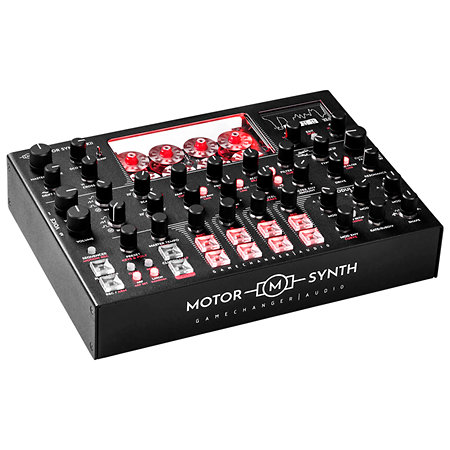
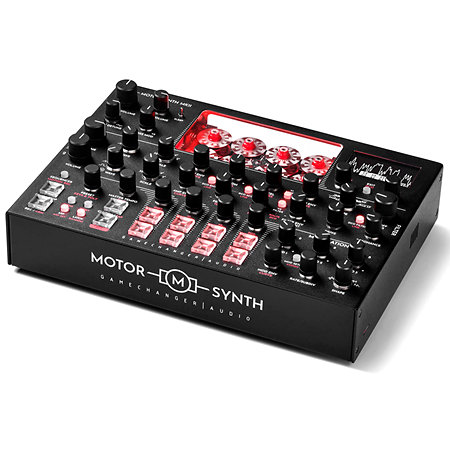
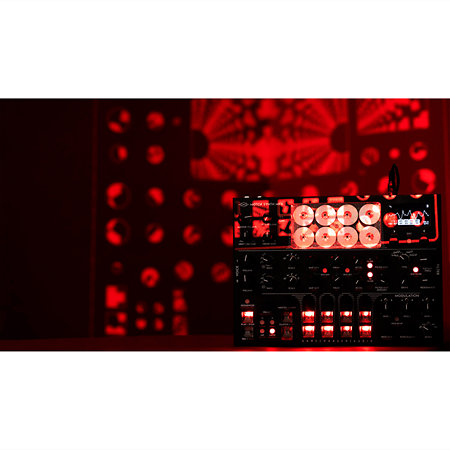
The MOTOR Synth is an analogue electromechanical synthesiser with an additional digital voice. It produces exciting industrial sounds with eight electromotors and features two independent voices with adjustable analogue filters. With a powerful modulation section and arpeggiator, this synthesizer offers a wide range of sonic possibilities. Compact and versatile, it can be used with MIDI keyboards, controllers and sequencers. Discover the unlimited creativity of MOTOR Synth!
ARTICLE N° 90494
Gamechanger Audio - Motor Synth MKII
Gamechanger Audio - Motor Synth MKII
1 665,83 €
excl VAT
including eco-part : 0,07 €
Out of stock
Guarantee 3
years
Fred
Eric
Do you need help?
Presentation
The motor synth is an analogue electromechanical synthesiser.
It uses electric motors as the main sound source instead of conventional oscillators.
The motor synth produces its main sound in two ways:
it accelerates eight electromotors to precise speeds that correspond to specific musical notes.
Each motor has a magnetic sensor placed next to it.
The rotating coils produce a very industrial, exciting and raw analogue sound.
Imagine eight motors turning in harmony and producing an intimidating noise! Special reflective discs are attached to the shafts of each motor.
Each disc contains a graphic representation of three standard audio waveforms.
Each waveform is read by an infrared sensor and converted into an audio signal.
Unique motor oscillator engine: the motor synth is based on a unique oscillator engine, a system of electro-motors capable of instantaneously and precisely changing their speed of rotation in order to produce musical notes.
these motor oscillators can produce four distinct waveforms - sine, saw, square and the so-called m waveform.
The M waveform is produced by a set of electromagnetic sensors placed next to the internal rotating coils of each motor.
As the coils rotate, the motor coils create electromagnetic fluctuations that can be amplified to produce a unique motor waveform.
Sine, saw and square waveforms are produced by a set of specially designed optical discs mounted on the shaft of each motor.
Each motor disc has three 'tracks' etched into its reflective surface.
These 'tracks' are designed as a circular optical representation of the sine and square waveforms.
Each reflective 'track' is associated with a separate infrared laser and a sensor that picks up the reflected beam.
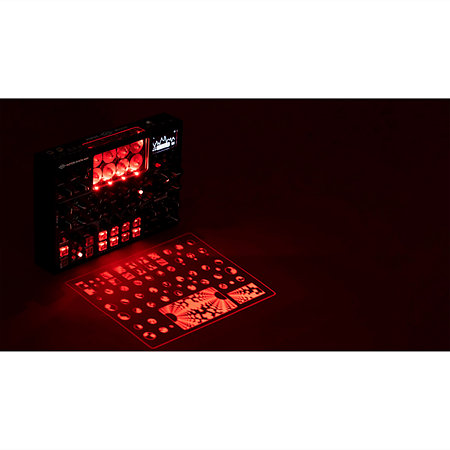
As the disc rotates and brings the differently shaded areas into circular motion, the infrared reflectivity sensor begins to produce an 'optical waveform', an exclusive technology developed specifically for the motor synth.
It uses electric motors as the main sound source instead of conventional oscillators.
The motor synth produces its main sound in two ways:
it accelerates eight electromotors to precise speeds that correspond to specific musical notes.
Each motor has a magnetic sensor placed next to it.
The rotating coils produce a very industrial, exciting and raw analogue sound.
Imagine eight motors turning in harmony and producing an intimidating noise! Special reflective discs are attached to the shafts of each motor.
Each disc contains a graphic representation of three standard audio waveforms.
Each waveform is read by an infrared sensor and converted into an audio signal.
Unique motor oscillator engine: the motor synth is based on a unique oscillator engine, a system of electro-motors capable of instantaneously and precisely changing their speed of rotation in order to produce musical notes.
these motor oscillators can produce four distinct waveforms - sine, saw, square and the so-called m waveform.
The M waveform is produced by a set of electromagnetic sensors placed next to the internal rotating coils of each motor.
As the coils rotate, the motor coils create electromagnetic fluctuations that can be amplified to produce a unique motor waveform.
Sine, saw and square waveforms are produced by a set of specially designed optical discs mounted on the shaft of each motor.
Each motor disc has three 'tracks' etched into its reflective surface.
These 'tracks' are designed as a circular optical representation of the sine and square waveforms.
Each reflective 'track' is associated with a separate infrared laser and a sensor that picks up the reflected beam.
As the disc rotates and brings the differently shaded areas into circular motion, the infrared reflectivity sensor begins to produce an 'optical waveform', an exclusive technology developed specifically for the motor synth.
Features
Type of sound generator
Analog
Number of polyphony notes
4
Arpeggiator
Yes
USB port
Yes
MIDI port
Yes
Analog output
2
Headphone output
Yes
Power supply
Power adapter (included)
Effects
compression
Other features
-
Gamechanger Audio Motor Synth MKII
-
Synthesizer
-
Operation : Analogue
-
Sound engine: electromechanical with additional digital voice
-
Signal path: all analogue
-
Polyphony: 4 notes, 3 voices per note
-
Filters :
-
Analogue multi-mode VCF 24 dB LP, 12 dB BP, 12 dB HP, 12 dB AP
-
Digital multi-mode VCF 24 dB LP, 12 dB BP, 12 dB HP, 12 dB AP
-
MIDI support: Notes, CC, PC, Transport, Ch pressure, NRPN, sysex - parameter dump
-
Presets and sequences: 128 banks of presets with 128 patches each, 64 projects/sequences
-
Display: OLED 128x64
-
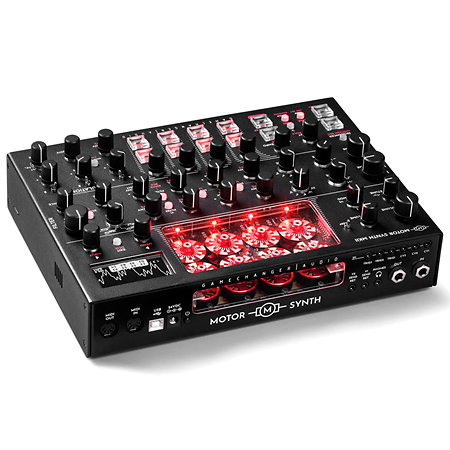
Connections:
-
IN, OUT: Ø6.35 mm jack
-
Headphone output: Ø3.5 mm mini-jack
-
V1 send/return, V2 send/return: 2x mini-jack Ø3.5 mm
-
3 CV triggers, 3 CV inputs: 6x mini-jack Ø3.5 mm
-
MIDI IN / Out: 5-pin DIN
-
USB-B: MIDI, FW updates
-
Storage: SD card
-
Input: TS unbalanced
-
Input impedance: 500kΩ
-
Maximum input level: 6Vpp (+9dBu)
-
Output: TRS unbalanced (stereo)
-
Output impedance: 220Ω
-
Maximum output level: 10Vpp (+13dBu)
-
Frequency response: 5Hz to 22kHz
-
Power supply: 5A, 24VDC adaptor supplied
-
Dimensions: 290 x 210 x 75 mm
-
Weight: 3.25kg
To find out more...
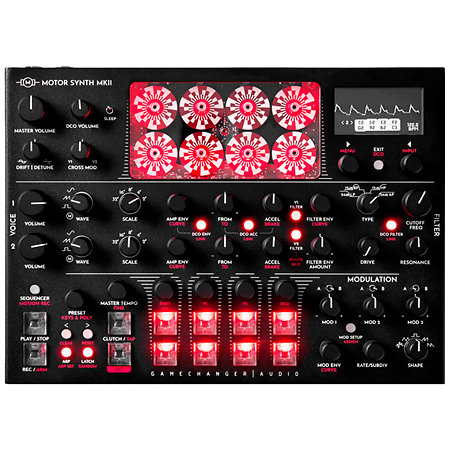
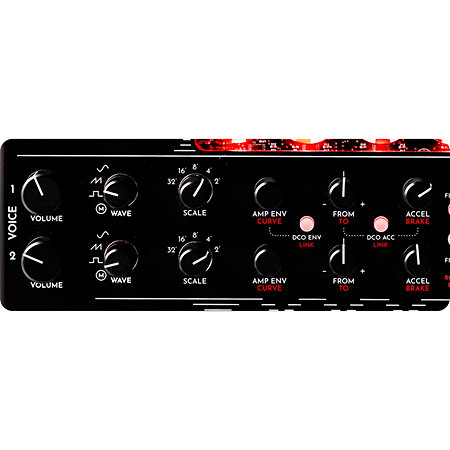
Two independent motor voices: the motor synth offers two separate motor voices with 4 electromotive oscillators each, the two voices can operate in mono, unison or four-note polyphonic mode.
Both motor voices are equipped with a separate set of controls for adjusting volume, scale, waveform, individual amp envelope motors for each musical note, as well as highly detailed control over a deep and versatile portamento / pitch mod section (called "acceleration / brake").
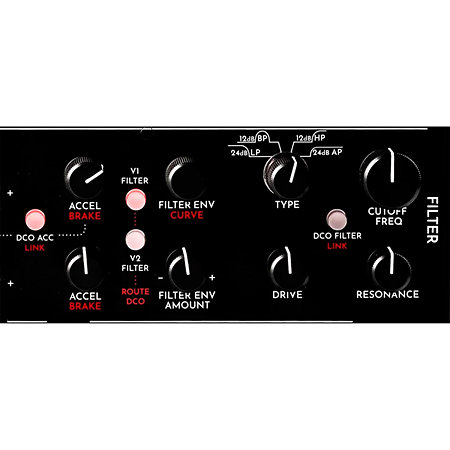
Independent multi-mode analogue filters: both motor voices feature a separate multi-mode analogue filter section with adjustable drive, cutoff, resonance, envelope shape & amount and filter type.
There are four types of analogue filter - 24 db lp, 12 db bp, 12 db hp, 12 db ap (all-pass).
The new analogue filter circuits have increased headroom, improved envelope response speed and a highly accurate analogue keytrack mode with adjustable filter depth, direction and 'glide'.
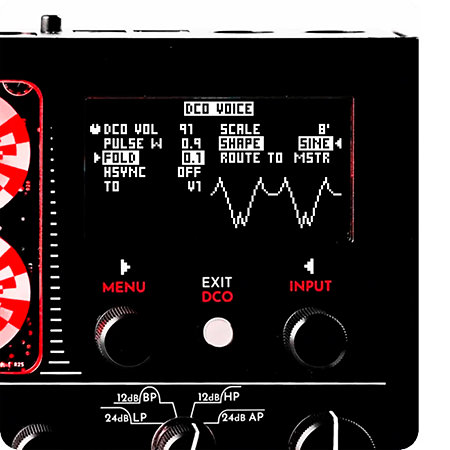
Digital voice (dco): the motor synth mk ii features an additional third voice - a high-quality digital motor that can be used either independently or to augment the raw sound of the motor voices.
The digital engine (dco) can be used to produce a variety of classic waveforms (with waveform shaping), or as a noise generator.
The dco is also equipped with a separate, fully controllable amp envelope and portamento section, and its own digital multimode filter designed to reproduce the 4 analogue filter modes.
Configurable stereo output the motor synth has a single output socket that can be configured as either mono or stereo output, routing the synth's two motor voices in separate channels. The digital voice can also be routed to the v1 or v2 outputs, or to both.
Modulation section with three assignable lfo's: the mkii motor synth also features an extremely powerful modulation section comprising 3 individual lfo's with adjustable positive and negative depth controls.
Each lfo can be easily assigned to almost any knob or encoder value on two independent modulation slots a and b.
There are five independent modulation waveforms available for each lfo - each with a detailed waveform shaping engine.
Cross-modulation and detune options: the motor synth has a dedicated central potentiometer for creating amplitude cross-modulation with voice 1 or voice 2. The detune / drift knob gives you two types of oscillator detune effect.
Arp, motion record, sequencer: the powerful arpeggiator engine offers detailed control over a wide variety of parameters, including note emphasis, pattern change, note repeat and more.
Multiple independent motion recording channels assignable to all sound parameters. A built-in monophonic sequencer engine with controls for micro-timing, probability, ratchets, pattern length, pattern saving and chaining and much more.
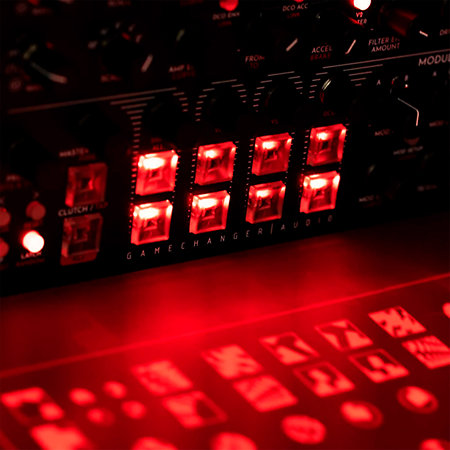
Performance keyboard: a non-velocity-sensitive 8-key keyboard with 4 pitch-shift encoders, this is a small but powerful note-entry system with plenty of performance tricks up its sleeve. Alternatively, the motor synth is fully midi and cv compatible and can be used with all your favourite keyboards, controllers and sequencers.
Both motor voices are equipped with a separate set of controls for adjusting volume, scale, waveform, individual amp envelope motors for each musical note, as well as highly detailed control over a deep and versatile portamento / pitch mod section (called "acceleration / brake").
Independent multi-mode analogue filters: both motor voices feature a separate multi-mode analogue filter section with adjustable drive, cutoff, resonance, envelope shape & amount and filter type.
There are four types of analogue filter - 24 db lp, 12 db bp, 12 db hp, 12 db ap (all-pass).
The new analogue filter circuits have increased headroom, improved envelope response speed and a highly accurate analogue keytrack mode with adjustable filter depth, direction and 'glide'.
Digital voice (dco): the motor synth mk ii features an additional third voice - a high-quality digital motor that can be used either independently or to augment the raw sound of the motor voices.
The digital engine (dco) can be used to produce a variety of classic waveforms (with waveform shaping), or as a noise generator.
The dco is also equipped with a separate, fully controllable amp envelope and portamento section, and its own digital multimode filter designed to reproduce the 4 analogue filter modes.
Configurable stereo output the motor synth has a single output socket that can be configured as either mono or stereo output, routing the synth's two motor voices in separate channels. The digital voice can also be routed to the v1 or v2 outputs, or to both.
Modulation section with three assignable lfo's: the mkii motor synth also features an extremely powerful modulation section comprising 3 individual lfo's with adjustable positive and negative depth controls.
Each lfo can be easily assigned to almost any knob or encoder value on two independent modulation slots a and b.
There are five independent modulation waveforms available for each lfo - each with a detailed waveform shaping engine.
Cross-modulation and detune options: the motor synth has a dedicated central potentiometer for creating amplitude cross-modulation with voice 1 or voice 2. The detune / drift knob gives you two types of oscillator detune effect.
Arp, motion record, sequencer: the powerful arpeggiator engine offers detailed control over a wide variety of parameters, including note emphasis, pattern change, note repeat and more.
Multiple independent motion recording channels assignable to all sound parameters. A built-in monophonic sequencer engine with controls for micro-timing, probability, ratchets, pattern length, pattern saving and chaining and much more.
Performance keyboard: a non-velocity-sensitive 8-key keyboard with 4 pitch-shift encoders, this is a small but powerful note-entry system with plenty of performance tricks up its sleeve. Alternatively, the motor synth is fully midi and cv compatible and can be used with all your favourite keyboards, controllers and sequencers.
Videos
You may also like




Spotlight on

Equivalent products
Gamechanger Audio - Motor Synth MKII
1 665,83 € excl VAT