
FILTER
FILTER



Waldorf - M
1 190,83 €
excl VAT
including eco-part : 0,90 €
In Stock
Usually ships within 48h
+infos
Guarantee 3
years

Fred

Eric
Do you need help?
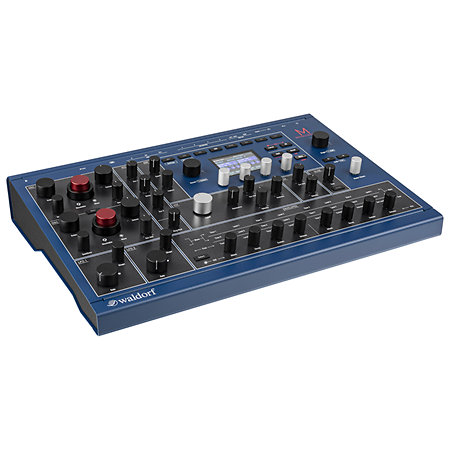
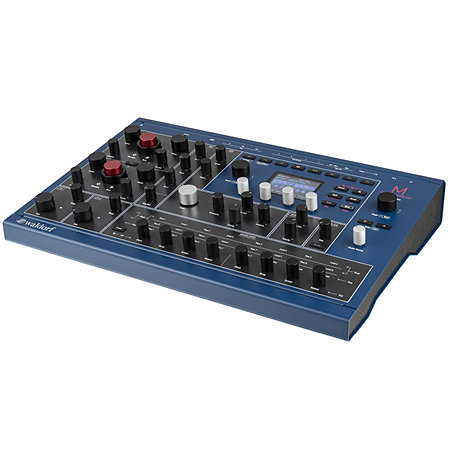
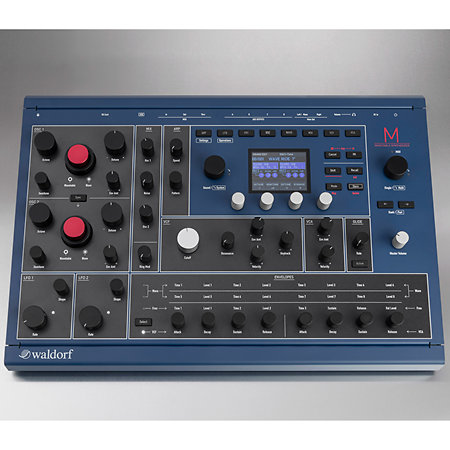
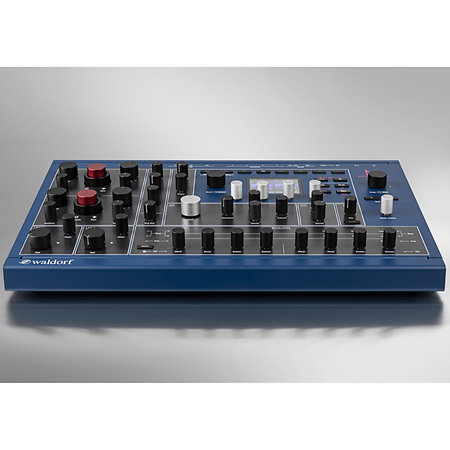
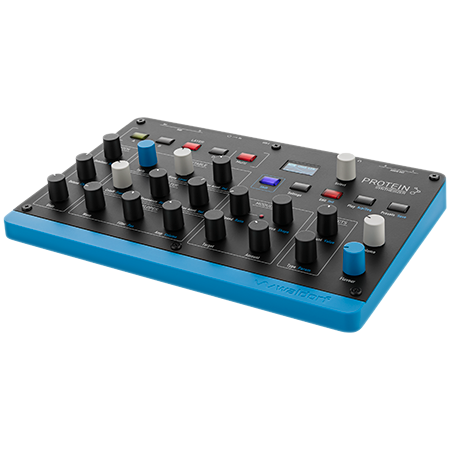
The M is a compact, new-generation hybrid wavetable synthesizer with eight polyphonic voices. It incorporates numerous presets, totalling 2048 sound programmes, and 2 wavetable oscillators with separate tone generators.
ARTICLE N° 84883
Waldorf - M
Waldorf - M
1 190,83 €
excl VAT
including eco-part : 0,90 €
In Stock
Usually ships within 48h
+infos
Guarantee 3
years
Fred
Eric
Do you need help?
Presentation
With the M model, Waldorf revisits its classics and condenses the Microwave and Microwave II sound generators for which it is renowned into a new-generation classic hybrid wavetable synthesiser.
It features a 24dB/Oct low-pass analogue VCF - SSI 2144 Improved Ladder Type - with analogue resonance and saturation, a stereo analogue VCA with panning option, and much more...
The internal memory stores numerous presets, with a total of 2048 sound programmes (divided into 16 banks of 128 sounds each).
Each sound has been professionally recorded by world-renowned sound designers.
As mentioned above, it features the classic Microwave soundtracks, plus the PPG Wave 2.3 sounds cleverly inherited from the original Microwave.
But the musical heart of M, as an eight-voice polyphonic, four-part multitimbral wavetable synthesiser, is formed by two wavetable oscillators with independent generation modes: Classic Microwave 1 and Modern Microwave II/XT.
Thanks to its advanced ARP with 16 pre-selected patterns, a tuning mode, and MIDI clock synchronisation capability, the M offers top-level performance in a compact desktop format.
Finally, for the most adventurous users, four programmable envelopes offer the ability to manipulate sound parameters via rate or time modulations.
It features a 24dB/Oct low-pass analogue VCF - SSI 2144 Improved Ladder Type - with analogue resonance and saturation, a stereo analogue VCA with panning option, and much more...
The internal memory stores numerous presets, with a total of 2048 sound programmes (divided into 16 banks of 128 sounds each).
Each sound has been professionally recorded by world-renowned sound designers.
As mentioned above, it features the classic Microwave soundtracks, plus the PPG Wave 2.3 sounds cleverly inherited from the original Microwave.
But the musical heart of M, as an eight-voice polyphonic, four-part multitimbral wavetable synthesiser, is formed by two wavetable oscillators with independent generation modes: Classic Microwave 1 and Modern Microwave II/XT.
Thanks to its advanced ARP with 16 pre-selected patterns, a tuning mode, and MIDI clock synchronisation capability, the M offers top-level performance in a compact desktop format.
Finally, for the most adventurous users, four programmable envelopes offer the ability to manipulate sound parameters via rate or time modulations.
Features
Type of sound generator
Digital hybrid-analog
Number of polyphony notes
8
Number of keys
0
Arpeggiator
Yes
Screen
Yes
MIDI port
Yes
Analog output
6
Headphone output
Yes
Power supply
Power adapter (included)
Color
Blue
Other features
-
Waldorf M
-
Synthesiser
-
4 times multitimbral (4 parts can be assigned to 4 individual stereo outputs)
-
2 wavetable oscillators
-
Separate wavetable sound generators: Waldorf Microwave I & Waldorf Microwave II
-
96 factory wavetables + 32 memory locations for user wavetables
-
24 dB/oct analogue low-pass filter (SSI 2144 extended cascade filter) with saturation
-
Analogue stereo VCA for each voice
-
8 polyphonic voices
-
4 envelope generators:
-
8-segment time/level wave envelope,
-
VCF envelope
-
VCA-ADSR envelope
-
Freely assignable 4-segment time/level envelope
-
2 LFOs with different waveforms
-
Arpeggiator with 16 pattern presets and chord mode
-
MIDI clock-synchronisable
-
2048 sounds & 128 multi-programs
-
Compatible with Waldorf Microwave I Sysex data (for sound bank transfer/sound transfer)
-
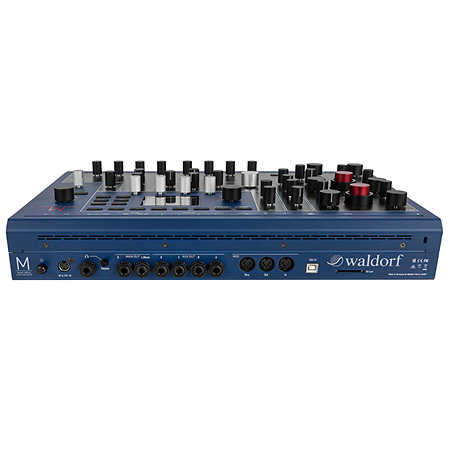
SD card slot
-
MIDI: USB 2.0 and DIN (5-pin DIN sockets for In/Out/Thru)
-
2 unbalanced 6.3 mm jack line outputs (L/R stereo)
-
4 stereo outputs on 6.3 mm TRS jacks (auxiliary A-D outputs)
-
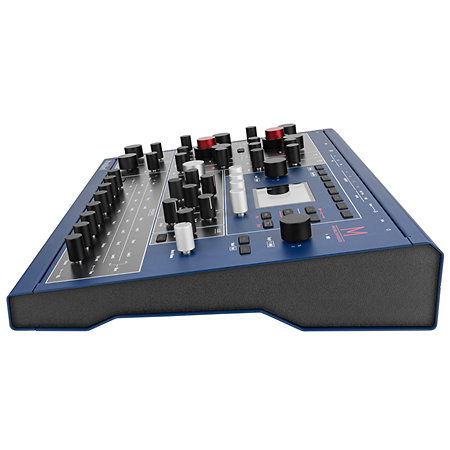
Dimensions: 440 x 305 x 85 mm
-
Weight: 5.7 kg
To find out more...
Waldorf, as a tribute to the Microwave of 1989, did not wish to incorporate a modulation matrix in this model. This is a conscious design decision to configure the modulation facilities directly on the corresponding display page and thus get closer to the original model.
You may also like





Spotlight on

Equivalent products
Tops of the brand


Waldorf - M
1 190,83 € excl VAT